Math Problem Design Studio
Students step into the role of problem designer, building original math word problems from a real-world scenario, then testing their design by having classmates solve it and catch the trap.
Your content has been saved!
Go to My Saved Content.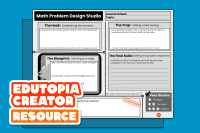


 Tagged as: Activity
How to use
Ideal for upper elementary and middle school students, this simple packet contains a one-page teacher overview of the strategy, a five-step “studio workflow,” and a student worksheet with a built-in, fold-under answer key. Print one worksheet per student (or pair), and walk through the workflow together before students start building.
The Design Studio Workflow
- The Hook: Establish a compelling real-world scenario.
- The Blueprint: Clearly define all knowns, unknowns, and constraints.
- The Trap: Intentionally add a distractor to test critical thinking.
- The Final Build: Synthesize all elements into a clear, solvable problem statement.
- Peer Feedback: The power of this activity lies in the peer feedback. Before swapping papers, the “Lead Architect” must fold the bottom “Quality Assurance Key” section under. Peers then solve the problem without seeing the solution. After solving, they unfold the key to verify their answer and rate it in the “Peer Review” zone.
Bonus: Add a brief reflection, either with the teacher or individually, as an exit ticket to close the learning loop.
This strategy empowers students to move from solving problems to designing their own. By creating, or even collaborating to create, math word problems in real-world contexts, they develop a deeper conceptual understanding of variables, constraints, and the underlying mathematics, which fosters ownership and creativity.
Activity inspired by and adapted from “Student-Created Math Word Problems Help Motivate Deep Learning,” by Matthew Vogel.