Routines That Support Math Fact Fluency
Regularly working with manipulatives can help boost second graders’ fluency and confidence in fundamental skills.
Your content has been saved!
Go to My Saved Content.
Math fact fluency—knowing and being able to recall math facts quickly and accurately—is an important element of being a successful mathematician at every age. To help my second-grade students grow their math fact fluency and confidence as mathematicians, I’ve developed a daily manipulatives routine focusing on addition and subtraction facts to 20.
Along with the daily routine, students take the same five-minute test once every week. I then chart their progress from week to week so they can see how much their math fact fluency has grown.
Here’s how the routine works.
Organizing Materials
Students engage in a four-part process matching tiles, small wooden blocks, or bottle caps with math facts on them. You can find small wooden blocks in mini block building game sets, collect bottle caps at your school, or use square math tiles. I prepare the baggies of manipulatives in advance, using a marker to write addition and subtraction expressions on some tiles and sums and differences on others. Each baggie has 10–15 facts in it.
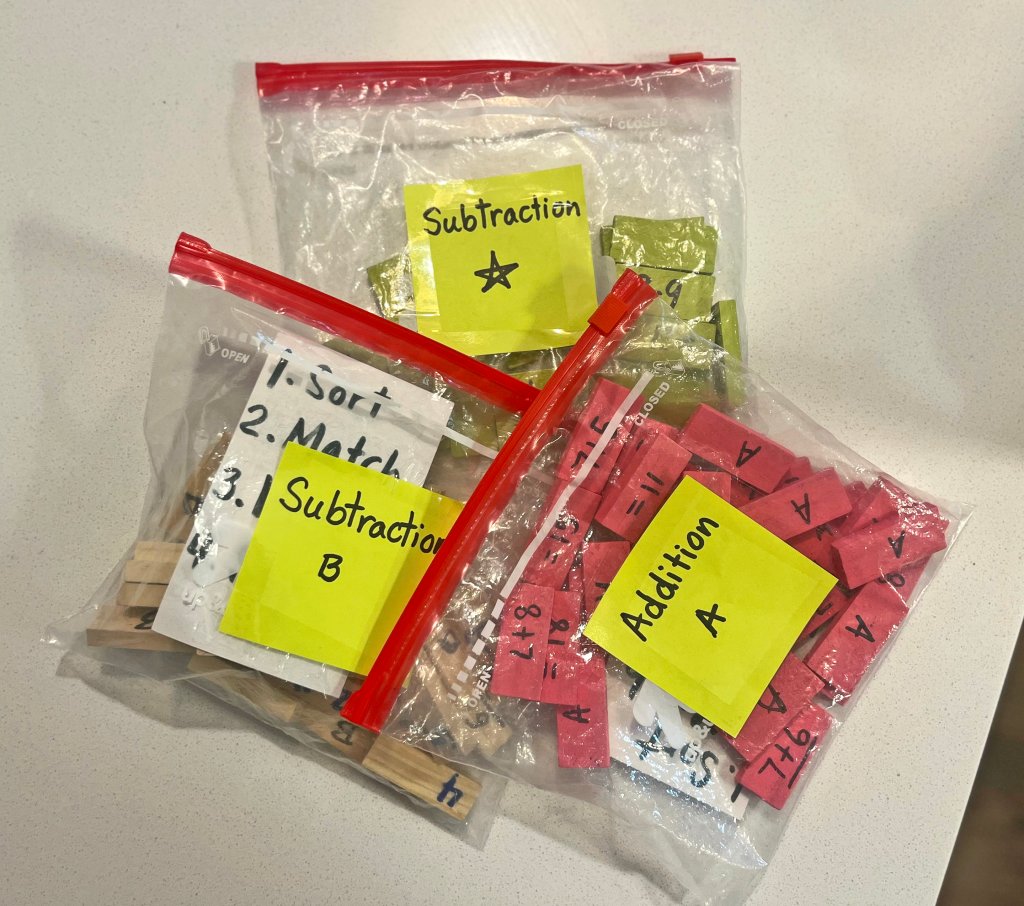
For organization, I place a letter or shape on the back of each tile, block, or cap in the bag, so that if they’re lost, they can be easily reunited with the correct set. (We have a “lost tiles” cup for stray pieces.) I place sticky notes on the outside of the quart-size zipper baggies so the students know if they are working on addition or subtraction. Finally, I underline 6s and 9s to avoid any ambiguity. Then students tackle the tiles in this order:
- Sort: Students sort the tiles into two piles—expressions and answers.
- Match: Students match each expression with the correct answer.
- Write: Students write the expressions and answers in their classwork journals.
- Say: Students recite the equations to themselves. (In my classrooms, students use a WhisperPhone—a simple tool that lets them hear themselves speaking.)
The four-step process allows students to engage in the learning in a variety of ways. Students may stand or sit at their desk during the task. Sorting engages cognitive processes in a nonthreatening manner and allows for movement, and the repetitive nature can be calming. Matching increases the cognitive demand; students are encouraged to find one familiar fact to start with, such as an expression with a 10 or double in it, and to then look for patterns from there. Using a pencil supports fine motor skill development, and saying the matched facts engages speaking and listening skills.
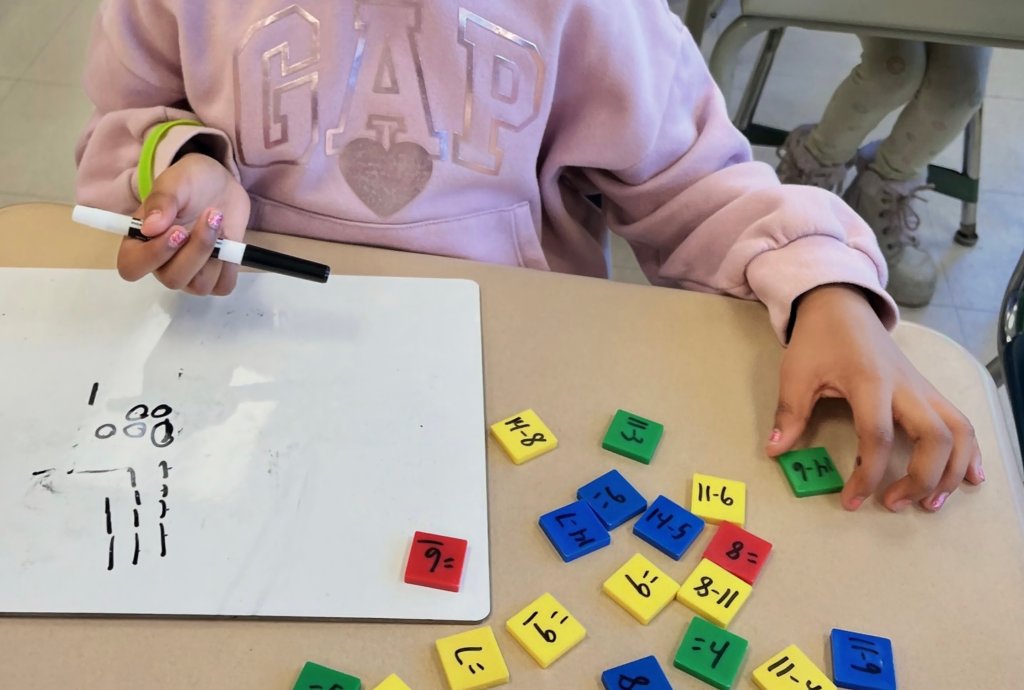
I provide scaffolds for every level of learning. I post an anchor chart for student reference with the four steps listed in order. Photographs of each step are on the poster for emerging readers. A small laminated card is in every baggie, with the four steps listed for reference if needed. Students who are in the early stages of acquiring facts may use a hundreds chart to count up and back as needed while working with the tiles. They may also use their whiteboard while they work. These supports provide choice to support agency and help students develop number sense and increase their confidence using these math tools.
Testing and Charting Progress
Each Friday, we take a five-minute test on addition and subtraction facts. Students with individualized education programs are able to use a hundreds chart during the timed test as an accommodation. There are 100 problems on the test. It is the same test each week. I then grade them and update our graph to show class progress. On Monday, students come in excited to check the graph and look forward to seeing their personal progress on the test in their take-home folder. This year, over a span of eight weeks, the class more than doubled their fact fluency, growing from a class average of 16 to 40 accurately answered facts in five minutes.
The graphing ties into our learning on data, and students shine with pride as they see the visual representation of their effort and success. The smiles and enthusiasm speak for themselves—as does the effectiveness.
I engage families by posting the graph on ClassDojo each week and sharing how proud I am of the students’ effort and collective growth. Families add positive comments that I share with my students so we are all invested in the process together.
I always tell my students: I don’t care where you start, but I need you to work hard so you can grow. The effectiveness of this activity is a great example of the growth that occurs with a simple and enjoyable routine. I know this work is a valuable and cherished part of our classroom culture when students begin to ask if they can use the tiles during other parts of the day, such as during morning work or when they finish an assignment. This shows me that students have embraced a growth mindset and they understand the value of practice to grow fluency and competency.
My big-picture goal is for them to take this thinking and growth model into other parts of their life, long after they have left my classroom and our math routines. Reflecting on our joy and progress in this work has me smiling—it’s as powerful for me as it is for my students.