A Collaborative Approach to Vocabulary Instruction
Elementary teachers can have students take on different roles and work together to build a more complete understanding of new words.
Your content has been saved!
Go to My Saved Content.
Vocabulary instruction wasn’t always the most exciting part of my elementary students’ day. But it is an important part of students’ language development and a crucial prerequisite for engaging deeply with increasingly complex texts.
So, I decided to try to do things differently. I came up with an approach that centers around collaboration and deep exploration of new words. In this multimodal approach, each student plays a part in building a full understanding of the word, allowing all students to learn new words while also building their ability to work effectively with their peers.
I call this approach our vocabulary investigation, and there are six different roles for students to take on. Using these different roles allows students to interact with the new vocabulary word in different ways, aligning with principles of Universal Design for Learning.
THE 6 ROLES IN A VOCABULARY INVESTIGATION
When introducing the vocabulary investigation for the first time, I like to make a big deal about the different roles to get students excited. I’ve found that giving each role a fun name also helps students feel motivated to take ownership of their work within the group. The six roles are outlined below, using the word uninspired as an example.
Coding Collector: Using a dictionary or a school-approved digital tool, this role looks for the meaning of the morphemes and/or syllables of the given word. For example, for the word uninspired the Coding Collector would find the syllables of un/in/spir/ed as “not,” “in/into,” “to breathe,” and “past tense.”
Synonym Searcher: Using a dictionary or a school-approved digital tool, this role identifies synonyms of the given word or related phrases. For example, for the word uninspired, this role might identify words like dull, unoriginal, or stale.
Antonym Ambassador: Similar to the role above, this role would identify antonyms. Using the uninspired example, this role may identify words including inspired, imaginative, or inventive.
Part of Speech Pioneer: This role is responsible for identifying the word as a noun, verb, adjective, or adverb. Additionally, this role prepares evidence to support their choice. For example, this role may say that uninspired is an adjective because it describes a noun.
Inquisitive Illustrator: This next role takes a more creative approach and creates an illustration to represent the word using text and graphics. For the word uninspired, this role may draw a person looking sad or bored, or include a speech bubble with no ideas inside it.
Detailed Describer: This role writes a detailed sentence that employs the word. As a guideline, I encourage students to avoid beginning with the pronoun “I” in order to write a more descriptive sentence. For example, a sentence may be “The movie was so uninspired and boring that everyone in the room fell asleep before it even finished.”
ENGAGING STUDENTS IN A VOCABULARY INVESTIGATION
To get started with a vocabulary investigation, it is important to first select the new word that you want to introduce to students. Once you’ve chosen your word, you can put students into groups of up to six. There are six different roles for students to play in the investigation, but depending on the number of students in your class, and how big you want the groups to be, you may have some students fill multiple roles.
Before beginning an investigation, it is also important that students understand how to use a dictionary or other digital tool that provides definitions for morphemes/syllables, and that students have a good understanding of what synonyms and antonyms are.
Once you’ve determined a word to study, have created your groups, and feel confident that students have the skills needed to use a dictionary, you can begin your investigation. I start by putting students in their groups and assigning a role to each student.
Students have one piece of paper each on which they write down the word and their role, and then complete any work related to their role (a drawing or a list of synonyms, for example.)
I give each group five to 10 minutes to complete their investigation and encourage students to work together, helping one another complete their part of the investigation when needed. As each role is completed, students check in with one another to make sure everyone is on the same page and understanding the word correctly.
After the five to 10 minutes are up, each group should have a strong understanding of the word that includes a breakdown of the morphemes, synonyms, and antonyms; an illustration; and a detailed sentence that uses the word. I then have the entire class come back together and share out what they found in their investigation, and we establish a shared definition of the new word as a class.
ENCOURAGING STUDENTS TO SOLIDIFY AND ASSESS THEIR UNDERSTANDING
Once the groups are finished, I like to give students an opportunity to solidify and assess their individual understanding of the new word. I have created a one-pager that asks students to put down everything they’ve learned through the investigation, along with a self-assessment of how well they understand the word.
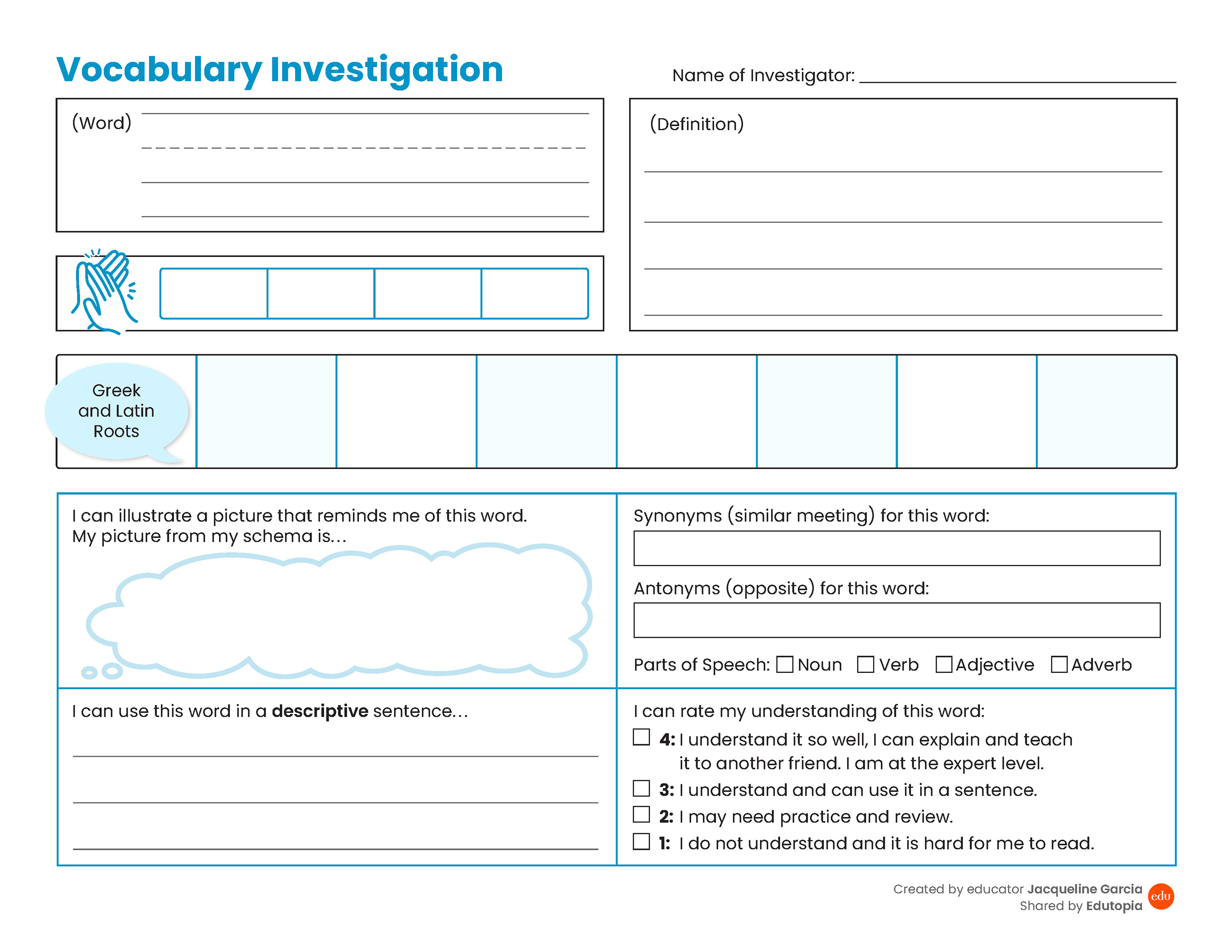
This process helps students commit the new word to memory and provides a reference for them to look back on if needed. Additionally, the self-assessment encourages them to reflect on the process.
All of the roles in the vocabulary investigation work together to help students explore new words in new ways. Through this collaborative work, students not only learn new words, but practice important communication and collaboration skills that help them find success in and outside our elementary classroom.