Setting Up an Intergenerational Reading Buddies Program
Elementary schools can use this framework to recruit adult reading buddies to help build community and students’ love of reading.
Your content has been saved!
Go to My Saved Content.
Growing competent readers is a goal of every elementary school. Building close connections with their community and instilling a love of reading in every first-grade student is the goal of an intergenerational reading program in Greendale Schools in Greendale, Wisconsin.
Reading Buddies, entering its 28th year in first-grade classrooms in this suburban Milwaukee school district, uses paper books and human interaction to help students learn to love reading. The program pairs an adult and a first-grade student for a weekly interaction that is all about reading. Adults from all walks of life—retired senior citizens, stay-at-home parents—act as buddies and a new person at school, showing students the importance of reading.
How Does the Program Work?
Great reading buddies programs at other districts will often use older students as the buddies, but what makes Greendale’s program different from most is the use of adult buddies. Our program pairs each first grader with an adult reading buddy for a weekly 20-to-30-minute reading session. Each adult buddy usually has two student buddies, although sometimes three.
In their weekly time with their adult buddy, each student reads one or more books aloud, possibly with some help from their buddy. The student then recaps the story of what they read while the buddy records the student’s comments on a worksheet, pictured below.
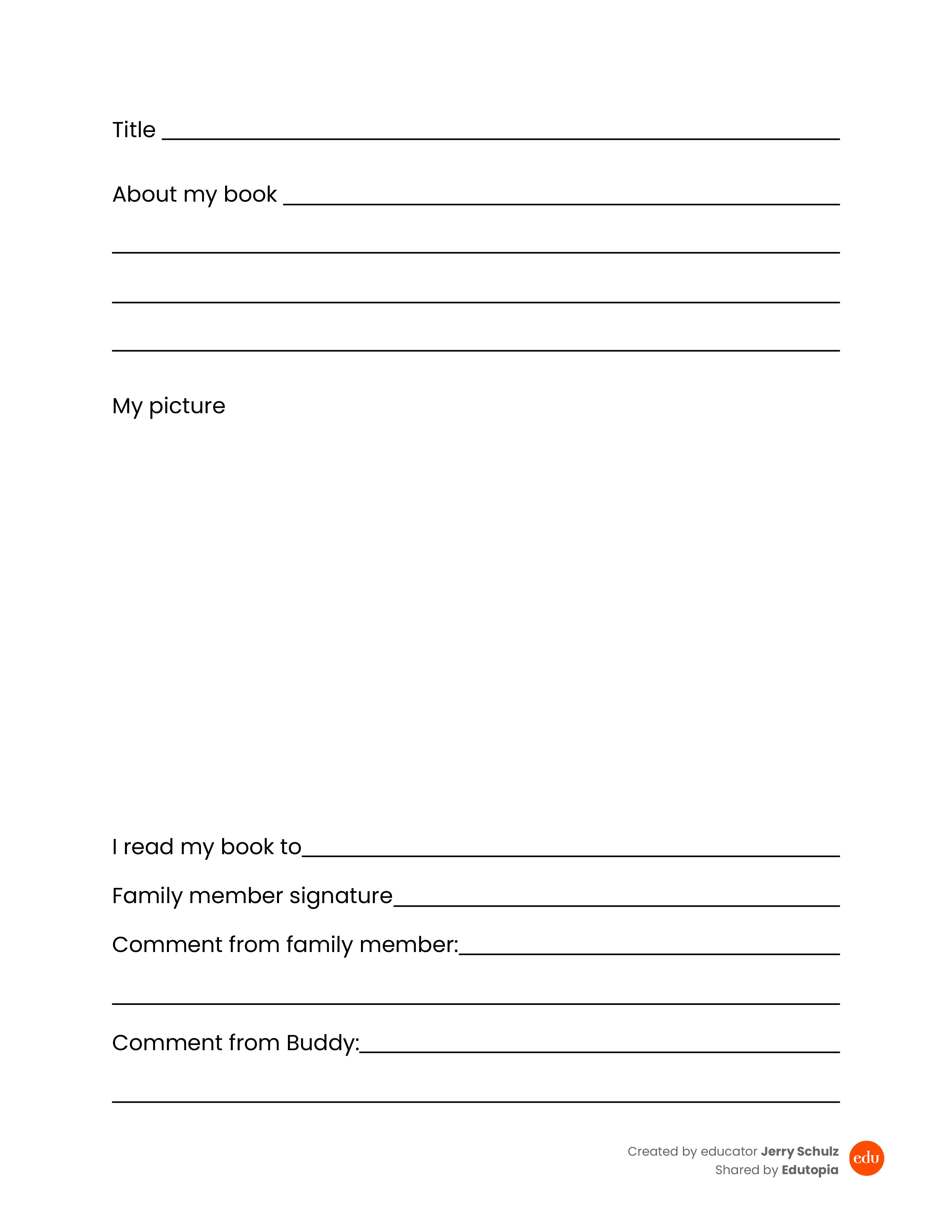
The student then takes their books home so they can read them again with family members at least one more time. The student may also draw a picture on the worksheet to illustrate the book’s story. The parent may then sign the worksheet and possibly add a few comments for the adult buddy, which helps the buddy see if their student is asking the parent to read with them.
The worksheets are clipped together in a paper binder. Each student is issued a distinctive book bag to carry their books and the worksheet binders to and from school. Students turn their book bags in at the end of the year, and the bags are then reused by the next year’s students.
The Reading Buddies program is scheduled for an hour in the morning at the same time each week (e.g., Tuesday from 10 a.m. until 11 a.m.). In the largest of the three schools, this schedule allows the program to use the school cafeteria for the session and make use of all the tables in the cafeteria.
Upon arriving for the weekly session, the buddies select books for their students to read that day from a small portable library that is used only by the Reading Buddies program. The books are sorted by six reading levels and marked with different-colored stickers, which range in difficulty from early readers to beginning chapter books. The driving concept of the program, of course, is that over the course of the school year, reading with their buddy will help enable the first graders to progress to more challenging books and greater reading proficiency.
At the start of the hour, the students in the first group each join their adult buddies for their 30 minutes together. The remaining students stay with their teacher, who has this opportunity for small group and one-on-one activities. When a buddy’s first student has completed their time, the student returns to the classroom and asks the buddy’s next student to come down to the cafeteria for their time with the buddy.
Program Management
The Reading Buddies program is complex, and it requires quite a bit of management. However, the management work is all provided by volunteers who are also buddies.
The districtwide Reading Buddy coordinator provides overall management of the program for all three schools. A main duty of the coordinator is to recruit and train the crews of buddies. The buddies tend to be of retirement age, although some parents and other younger adults who have flexible work schedules also participate. The coordinator also manages the program library, creates the weekly schedule, and pairs volunteers with students.
Buddies are recruited through school district communications platforms, social media, and often word-of-mouth promotions. Interested individuals are asked to reach out to the district coordinator for more information and an interview, and must also complete a background check in accordance with the district’s volunteer policy shared on its website.
With one buddy for every two students, the program requires approximately 70 buddies across the three schools. Each school also has a small crew of substitute buddies. The district coordinator works diligently to set the schedule and pair the buddies with their students. The district coordinator also recruits volunteers to serve as school leaders at each of the three schools as well as classroom leaders from among the buddies to coordinate each classroom.
At each session, the classroom leader ensures that all the classroom’s buddies are in place and then manages the traffic of students coming to and from the cafeteria. Additionally, there is a substitute manager in each school who arranges for subs when buddies are absent.
If buddies know in advance that they will be absent, they fill out a form with information on their students, or the substitute manager can take this data over the phone or by email. Buddies are asked to request subs as far in advance as possible, although of course illnesses can cause last-minute requests.
The week before the first session with the students, each school holds a kickoff orientation session for the buddies. Topics for the orientation include the basics of managing the weekly encounters with the students, the year’s schedule and dates off, the process for requesting a sub, the assignment of students to buddies, and the table assignments.
The last session of the year is a party at which each student receives a book they select as a gift.
The Reading Buddies program is funded through donations and not by the school district. Funds received are used to buy new books and to pay for other program expenses, such as folders, copy paper, and snacks for the opening and closing events. Each year the program builds the library of books, replacing those that are worn, and adds books that are especially popular with the students.
Participation in Reading Buddies helps students understand that their success impacts more than themselves. They learn, with a new person who loves to read, how being a successful reader and a successful student brings pride to a whole community. At the end of the year, students love to read—especially with their buddy.
I’d like to thank my colleagues Carol Richards and Kitty Goyette for their contributions to this article.