Using Louis Armstrong’s Scat Singing to Build Literacy Skills
This “scat-step-segment” routine helps students experience language in a fun, musical way that feels natural to them.
Your content has been saved!
Go to My Saved Content.I spend my days as a literacy specialist supporting upper-elementary students develop reading, writing, and spelling skills. I have traditionally relied on the same methods most teachers use when trying to help children understand how to identify syllables in words: the usual claps and taps, and sometimes the “jaw-drop” method, where students notice the way the jaw falls a bit with each sound segment. I’ve also watched too many students go through the motions without really feeling the rhythm of the words. My students were doing what I asked, but with no spark, no fun, and little engagement.
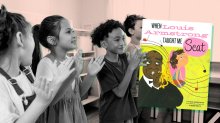
One day, we had an exciting event at our school: R. Gregory Christie, a children’s illustrator, was visiting to talk about his work on the book When Louis Armstrong Taught Me Scat, by Muriel Harris Weinstein. Christie’s artwork is bold and eye-catching and pulls students into the book long before the reading ever begins. As I meandered past the display table, I remembered the way my father used to play Louis Armstrong’s big beat music throughout my home as a child—and I was drawn in instantly.
Unbeknownst to me, the way that I approached teaching children about syllabication was about to change. The book’s playful rhythms gave my students a foundation—a starting point with sound awareness—that was necessary to make word structure instruction explicit. Here’s how I use this book to teach reading in my classroom.
Introducing Scat Through Text
The lesson begins with a read-aloud of When Louis Armstrong Taught Me Scat. Before we even open the cover, I introduce students to Louis Armstrong as a great jazz musician, nicknamed “Satchmo” by his closest family and friends. This name affectionately implied that Armstrong’s wide smile was as big as a satchel and was always filled with music.
I continue to give students background on Armstrong’s upbringing in New Orleans, when people were often judged by the color of their skin. Louis Armstrong overcame this injustice by turning to music to express himself. I also share the story of Satchmo losing his place during a musical performance; rather than stopping, he began singing playful nonsense sounds to go along with the music. He turned a mistake into a new way of using music to express joy and creativity. I remind students of my favorite saying when we make mistakes: “Mess it up, Dress it up!”
As we dive into the book, Christie’s illustrations and the sing-song prose from Weinstein create excitement. A natural beat begins to emerge with the reading, much like in the book Chicka Chicka Boom Boom, by Bill Martin Jr. and John Archambault. The children are slowly but surely setting the stage for a lesson in the rhythm and rhyme of words.
After the read-aloud, I play a short clip of Louis Armstrong scatting. As soon as Armstrong’s deep, playful voice fills the classroom, students’ expressions shift to wide-eyed grins and giggles. I pause the recording, giving time to discuss the “why” behind the sounds. I share with students that Armstrong’s voice is often called “gravelly” because it sounds like a bumpy road, but it was a voice that he loved because it was unique and all his own. The students immediately ask to hear it again, because it’s fun!
The Scat-Step-Segment Routine
Once the students learn about the history and have had a chance to listen and feel the beat of scatting, we move into the all-important connection to literacy. This three-part routine is the heart of the lesson.
Scat. I model a short scat phrase like “bop-doo-bop” or “sha-la-dee.” Students echo the phrase back to me. By beginning with nonsense words, we remove the pressure of “correct” reading and focus entirely on prosody, the natural rhythm of language.
Step. Next, I invite students to stand up, to step or tap the beat of the scat line. I’ll say, “Let your feet show the rhythm.” This physical movement is a valuable way for students to externalize the beat, thereby creating a sensory anchor for the pattern. I play the scatting clip again to give students time to feel the rhythm with their bodies.
Segment. Finally, we shift from nonsense words to real words: music, funny, rhythm, elephant, celebrate. Students step or clap the syllables of the word and compare the feel to the scat pattern. This comparison creates a powerful bridge. Instead of counting syllables as abstract parts of words, students experience syllables as the beats of a story. They begin to understand that syllables are not just parts of words, but the beats of language.
During one first-grade lesson, after we practiced echoing, a student named Maya raised her hand quite energetically to share, “I think el-e-phant feels the same as ‘bop-doo-bop.’” Not waiting for confirmation, Maya proceeded to step it out, one-two-three, with each confident step landing on the beat. Then, Jordan jumped in with, “Wait! Mu-sic is two beats, just like my name, Jor-dan!” In no time, my classroom was transformed into an exploration of language where students were comparing patterns and using their bodies to “show” the language.
Why This Works
What struck me most about this lesson was how naturally the students transferred the rhythm of scat to the rhythm of words. Research on embodied literacy reveals that the movement involved with scatting in this way strengthens memory and fosters a deeper, contextual understanding. The beats themselves became this wonderful bridge into structured analysis of syllables. This experience also provides a clean entry point for my students, most of whom struggle with phonological tasks.
This lesson also honors the culture of an important Black musical tradition. Students learn foundational literacy skills while engaging with this beautifully rich art form, which is a meaningful step toward culturally sustained pedagogy. This approach is also supportive for multilingual learners and students who benefit from multimodal instruction because the layers of rhythm, movement, and sound create multiple pathways to understanding.
When syllables are taught through rhythm, movement, and culture, we are exposing our students to much more than a new skill. We are providing an opportunity to experience their language in a fun, musical way that feels natural. Satchmo’s story turns the mundane clapping and tapping routine of old into a whole-body experience in the rhythms of the English language. In this intersection of music and literacy is the secret sauce, where students are learning not only to count syllables, but to find joy in the everyday sounds of a language they are striving to become more familiar with.