Teaching Preschool Students About Insects
A super-engaging variety of indoor and outdoor activities for all seasons, plus bug-related books.
Your content has been saved!
Go to My Saved Content.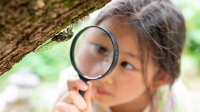
My pre-K students always jump at the opportunity to explore nature, and they also love digging into bugs.
I previously assumed that lessons about insects were only possible in the springtime, but that’s not true—there’s actually lots to teach all year long. Some insects, for instance, lay eggs only in the winter. Carpenter bees enter diapause to wait out the cold months, while monarch butterflies migrate south to warmer climates.
Six years ago, I started planning out learning centers and outdoor activities about wiggly, crawly critters. I’ve since gleaned that kids tend to gravitate toward sensory buckets, dramatic play opportunities, and nonfiction books about bugs. Some activities and readings make more sense indoors (yes, occasionally with real bugs!), while others are best outside, where biodiversity shines. Below are my students’ favorite insect-related activities, as well as their favorite bug-related books.
Indoor Activities
Bug tracks: This activity features homemade play dough—preferably pine-scented and filled with twigs and pebbles—or paint. Students use realistic-looking rubber bug toys to make tracks in the dough or paint, and check out the footprints (or wing prints!) that are left behind. My students tend to focus on the similarities and differences in footprints, like how dragonfly wings are narrower than butterfly wings, or how spiders have eight legs but ants have only six.
Camping bucket: When I’m building a sensory bucket, I prefer a 32-quart bin with a lid to help with storage and clean-up. I add a filler for the base (usually a gallon bag of dry pinto beans). From there, I drop in elements that follow the theme of being in the woods: round wood cuttings, real or fake leaves, twigs, small stones, and pine cones. Students love the variety of textures. I finish off the tub with realistic-looking fake bugs. Often, I find kids lining up the wood cuttings like a path, so their bugs can “walk” through the forest of pine cones and leaves. The bin comes together very quickly when you have all the materials, and it allows for two or three students to play at a time.
Bug identification: My students enjoy becoming entomologists and learning about bug specimens. I allow two or three students at a time into my dramatic play area, and I supply each of them with magnifying glasses and lab coats. I print photos of different bugs, which the students hang in our dramatic play area, and then I pass around clipboards and pencils. Students use the magnifying glasses to get a closer look at the bug photos, and they jot down sketches and vocabulary words, too. I’m always surprised at how readily students copy down new terms like “orb weaver spider” and “rainbow stag beetle.”
National Geographic videos: I always play National Geographic videos about real insects, so students can watch how they move, how they grow, what they eat, and what eats them. I tailor the videos to the interests of my students, like following the life cycle of a ladybug or exploring how an ant colony thrives beneath the surface. Kids can certainly be squeamish about bugs, so be careful about which clips you pick.
Outdoor Activities
Indoor centers are great, but nature exploration is even better. Just remember: Teachers set the tone for how students should interact with insects. If creepy-crawlies make you bug out, I’d recommend inviting a paraprofessional or team member to help with hands-on, outdoor lessons.
Worm walk: The fresh, wet smell of earth after a spring shower is a great sign that it’s time for a worm walk. I tell my students we’re going to go hunt for worms, but before we go, we have to talk about kindness. Students are asked to handle the worms gently—they should not squish or squeeze them. They’re reminded that it’s OK if they don’t want to touch the worms, but they’re still encouraged to look while the teacher or a friend holds them.
This activity varies depending on the soil around your school. I’ve gone on digs at the playground where we didn’t find anything, and other times where we only found a few worms near flower beds or fresh sod. If you can’t make it to an outdoor hunt, there are work-arounds. For instance, I’ve picked up worms from a bait shop, filled a small tub with soil and the worms, and then passed the tub around during circle time, so that students can “dig” with their hands.
Butterfly life cycle: One of our school’s science standards is to go over the life cycle of a butterfly, and what better way to demonstrate that life cycle than with real caterpillars? Over the course of a few weeks, my students watch the caterpillars grow and make their chrysalis. I keep the bug enclosure out so it can always be viewed, and we take time each morning to discuss any growth and changes we spot. We then have a release ceremony on the front lawn of the school. As a bonus activity, we always vote on what to name the butterflies.
Nature explorers: I’ve found that pre-K teachers can never go wrong with a general exploration activity. I pass out magnifying glasses, tell students where to search for bugs (usually at the playground, in grass, on flowers in the flower bed, or crawling up trees). We also go over insect safety rules. In short: Don’t touch any insects you find, don’t put your hands in dark places, and be respectful of nature. I also bring a camera so I can capture students’ best findings.
Books About Bugs
Science lessons about insects always benefit from children’s books, which allow students to slow down and take a deeper look at the world around them. Consider some of these great titles, which connect with insect themes.
The Very Hungry Caterpillar, by Eric Carle: This classic always delivers because of its predictable structure and beautiful artwork. It regularly inspires students to use watercolors and paint their own caterpillars.
The Very Impatient Caterpillar, by Ross Burach: Consistently a huge hit, this silly book focuses on the difficulty of waiting during the chrysalis period, which is especially hard when you’re feeling impatient. While the story is full of laughs, it connects to social and emotional goals of waiting your turn and understanding that some skills take time to acquire.
Diary of a Worm, by Doreen Cronin, illustrated by Harry Bliss: Though this book can be a little hard to read all at once, its diary structure is a fresh take for a read-aloud; it perfectly tees up the worm walk activity by getting students curious and excited to find worms themselves.
The Big Book of Bugs, published by DK: Nonfiction books are equally important during read-alouds—they introduce fun facts and photos of insects, including insects that are local to your region. Aided by The Big Book of Bugs, my students recently did a deep dive about beetles. Later, I printed photos of beetles to make a bug collection journal that students could sift through.