A Case for Conferencing With Students Instead of Giving Written Feedback
Holding a 15-minute meeting with each student creates a chance to discuss what’s working in their writing and what they think about it.
Your content has been saved!
Go to My Saved Content.
It was another late afternoon, and I was still at it, doing my best to fill out rubrics and also give written feedback to a stack of junior essays on whether the American colonists acted justly by rebelling against British rule.
Before I handed back that first substantial work of the year, I gave my classes what I call a “state of the heart,” a short talk about the intent behind my feedback. I knew what would happen when the papers went back. Most students would flip straight to the grade and ignore the rest.
“My hope is that you will slow down anyway and sit with what I’ve written,” I told them. “Every comment comes from a place of caring. I want each of you to improve, and I want you to know that I’m in your corner as you do. I am here to build you up, not tear you down.”
But no matter how sincere I am, my words sometimes fall on deaf ears. Some students still hear my feedback as an attack, even after 20 years of honing how I deliver it. That’s why I made a pivot halfway through the year. Here’s what I do now.
Putting the Rubric in Their Hands
I have students assess their papers, filling out a rubric as honestly as they can, right after they submit their work. I complete a rubric of my own as well, but they don’t see it until after we meet.
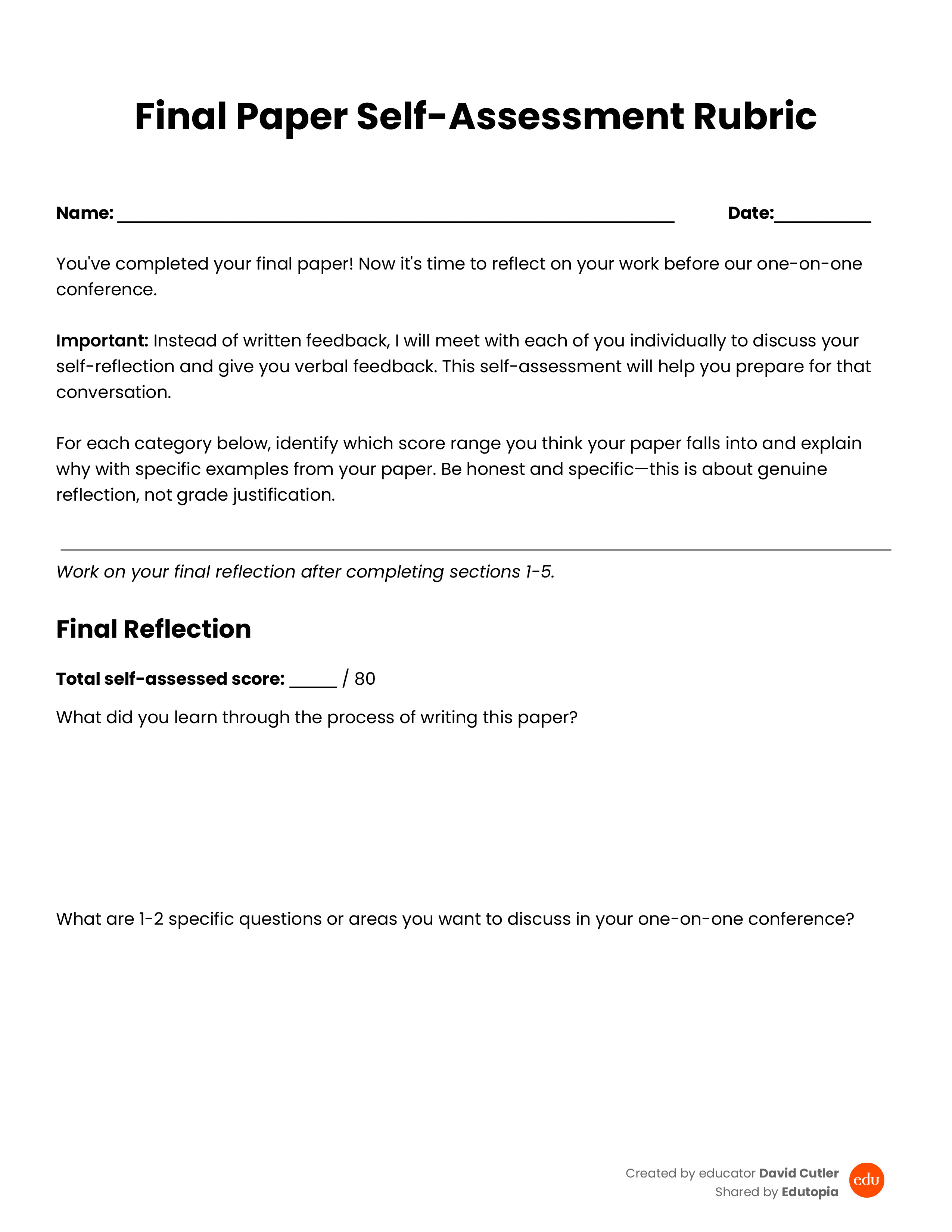
At first, students felt uncomfortable grading their own writing, even though they’d already done this for weekly breakout seminars. There’s something about the written word that feels more personal, and my students openly admitted apprehension about being too generous or too hard on themselves.
We now spend a period or two assessing anonymous work from former students. In small groups, my students sort the samples and choose one excellent, one solid, and one piece that clearly struggles. Then, they score each piece using the same criteria that I present to them in the self-assessment rubric. Afterward, we come together to compare scores and talk through our reasoning as a class.
How The Meeting Proceeds
Once the students finish their work, they submit their paper and the completed rubric. What’s most crucial is that they evaluate their own work before they see a single comment or mark from me, which keeps their initial judgment unclouded.
I email my students a sign-up sheet, and they choose a 15-minute slot during their class period to meet with me. If a conversation needs to go longer, we continue it in a later class or during a shared free period.
With only 12–16 students per 50‑minute section meeting four times a week, it still takes four or five meetings to get through everyone, but the investment is entirely worth it. I don’t offer written feedback anymore, but I read each paper in advance so I can come prepared—to praise how a student handled a transition, for example, or gently ask what they meant in a particular passage.
Students read my body language and tone differently than they read comments in the margins. Yet another student told me, “I used to think a lot of comments on my paper meant you were mad. Now I get why you wrote what you wrote because you’re right there explaining it.”
These conversations also let me ask students about their use of sources and raise any concerns without accusing them of dishonesty. If they can’t explain why they cited a particular source (like one about World War I when it’s for a Civil War paper), that raises a red flag about the work’s authenticity—and I let them know it.
At the end of each meeting, we compare rubrics. I tell students that if we land only a few points apart, I won’t push too hard; it’s not worth a prolonged debate. When the gap is wider, I take more space to explain why I think the grade should be different, and almost always they end up agreeing. Strangely enough, when I do adjust a grade, it’s more often to raise it than to lower it. All of this builds trust and transparency, which encourages students to submit optional drafts for additional feedback.
This isn’t just my experience; the research backs me up. In their influential 2007 paper “The Power of Feedback,” education researchers John Hattie and Helen Timperley found that students who build self-assessment skills come to “know how and when to seek and receive feedback from others,” rather than treating feedback as something to be feared or ignored.
Hattie and Timperley don’t address face-to-face feedback specifically, but they do note that it’s most effective when it doesn’t feel threatening to a student’s sense of self—and in my experience, that’s far easier to achieve in conversation than in the margins of a paper.
Last semester, I ran this process twice—once for a weighty in-class document-based question response on Reconstruction, and then for a take-home essay on whether President Truman acted justly by using atomic warfare to end World War II. For smaller assignments, such as reading or source reflections, I will continue to offer brief written feedback.
What About Larger Classes?
Teachers at schools with larger sections can adapt this model by adjusting the length and scope of the assignment. You might hold shorter conferences, assign fewer major projects each term, or spread conferences out over two weeks instead of one. In every case, students should have meaningful work to do while you meet with one student at a time.
Depending on the week, they might work on a small group project tied to our unit, move through a multiday simulation, or read ahead for an upcoming seminar. The gallery walk is especially handy; students visit stations at their own pace, so anyone who steps out to meet with me can easily make up for the missed activity.
I still read every word of my students’ work. But now, instead of providing written feedback that might go unread, or be perceived as condescending when I meant to be encouraging, I look forward to face-to-face meetings where I know I’ll be heard—and my students will feel heard, too.