3 Ways to Set Boundaries to Protect Your Time and Energy
Implementing specific strategies can help you prioritize your time, protect your peace, and help you connect to things that energize you.
Your content has been saved!
Go to My Saved Content.
Did I do enough? This is the question that haunted me as an educator. We care so deeply about those we serve, and that’s important, but it’s also exhausting. It’s an honor and it’s heavy.
Social scientists define mattering as the experience of being noticed, valued, and needed. Teachers may not always feel noticed or valued, but there’s no question that they are needed. Educators make a myriad of decisions each day in response to the academic, social, emotional, and behavioral needs of the humans in front of them.
Education is profoundly rewarding, but we can’t ignore the toll. When being needed is constant and the stakes are so high, we can see burnout, anxiety, sleep disruption, compassion fatigue, disengagement, and rising attrition, with ripple effects that touch learners, teams, and entire communities.
The issue isn’t how deeply we care. It’s that we care without setting boundaries.
I recently interviewed Jennifer Wallace, author of Mattering: The Secret to a Life of Deep Connection and Purpose, who described what happens when we begin to matter too much to others and not enough to ourselves. As she put it, “A true sense of mattering, the kind of mattering that allows us to thrive, is when we balance our own needs with the needs of others.”
So how do educators manage caring for others and themselves? Here are three practical ways to cultivate healthy mattering by protecting your time, attention, and energy.
1. Go Upstream (and Bring a Filter)
Time is a finite resource, and protecting it often comes down to a two-letter word many of us struggle to say: no. Enter a tried-and-true tool, the Eisenhower Decision Matrix. This tool guides us to categorize tasks by whether they are important, urgent, both, or neither.
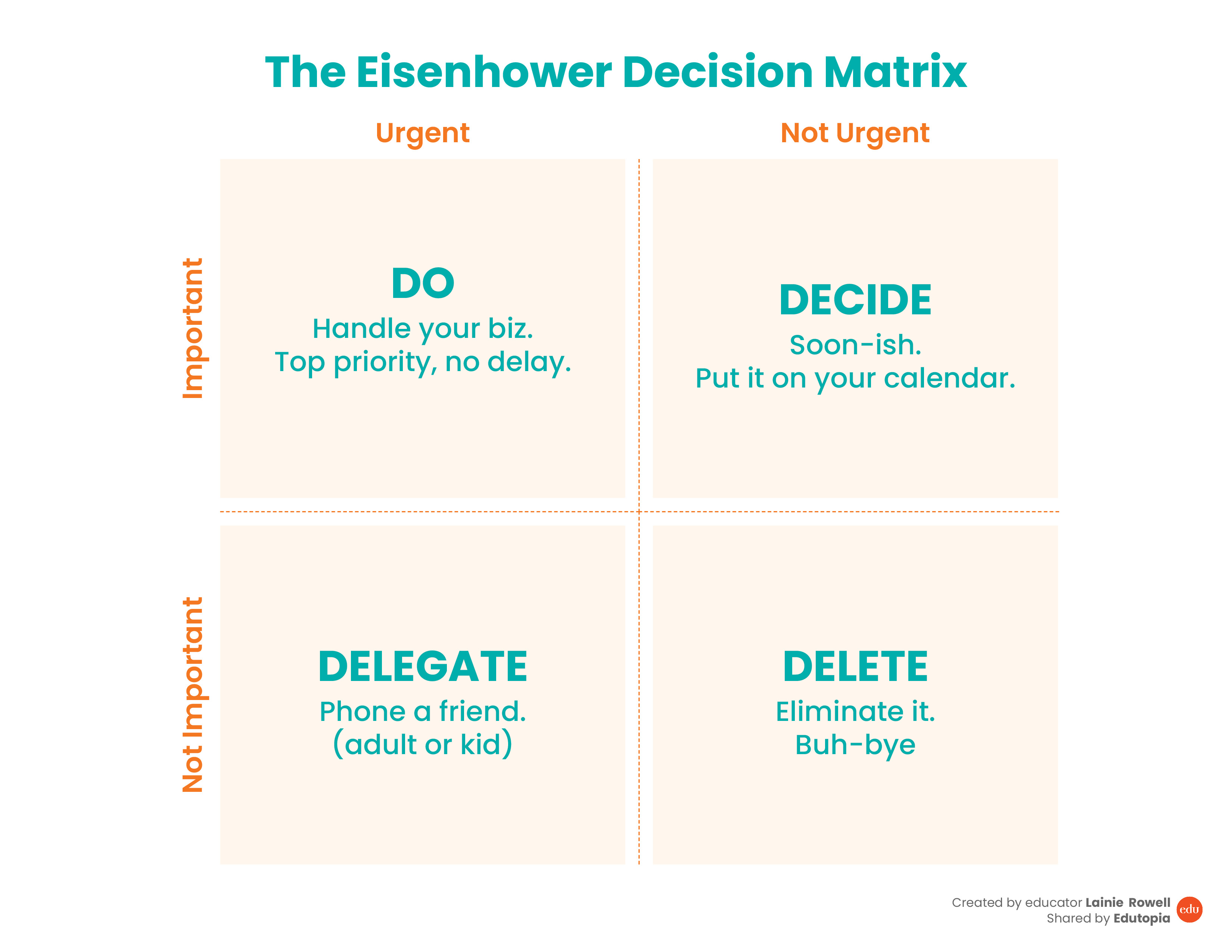
- Important and urgent: Do.
Handle immediately. Top priority. - Important but not urgent: Decide.
Schedule it. Put it on the calendar. - Urgent but not important: Delegate.
Ask for help or pass it on when possible. - Not urgent and not important: Delete.
Eliminate it. Let it go.
Let’s take it a step further and use it as a filter. We can use the matrix before we commit, rather than after we’re already overwhelmed. I keep the graphic above next to my computer as a visual cue to keep me on track. Whether it’s my idea or someone else’s request, I use the matrix as a proactive boundary tool.
One thing I do as often as possible is delegate to learners. Learners need to know they matter too, and delegating is about stepping back so they can step up.
Bonus filter: Ask yourself, “How would future me feel about me saying yes to this?” We’re often inclined to be generous with future me’s time, but it’s important to protect ourselves in the present and in the future.
2. Keep the Receipts
Here’s what’s wild: We can feel desperately needed yet still unnoticed and undervalued. We don’t always know our impact, and as humans, we come preloaded with a negativity bias.
Even when we experience wins throughout the day, we overwhelmingly notice the things that didn’t go our way. We can overcome this evolutionary adaptation by focusing our attention on process over outcomes and by practicing gratitude. To be clear, gratitude isn’t about ignoring what’s hard; it’s about refusing to overlook what’s good.
Try this Keep the Receipts gratitude practice by completing the following prompts:
- I felt noticed or valued when…
- I set a boundary and still mattered when…
- I left something better when I…
We don’t want to miss the moments that make us feel noticed and valued, so let’s “Keep the Receipts” and collect proof of what’s good, even when the work feels heavy.
3. Protect the Micro Moments
When energy is depleted, it’s hard to imagine doing more. But here’s the paradox: The rituals that restore us are often the first things we abandon when we’re overwhelmed.
Our minds lie to us, telling us we’re too tired to move our bodies, that binge-watching will reset us better than activities that bring us flow, and that we can skip the small practices that actually give us energy back.
Maybe it’s one meal a week with colleagues instead of another sad desk lunch. Maybe it’s a walk around campus before school starts. Maybe it’s 10 minutes with a puzzle, a podcast, or a journal. Maybe it’s 90 seconds to close our eyes and really breathe.
And while individual strategies can’t fix systemic problems like understaffing and unrealistic expectations, we can choose our micro moves that keep us going while we work toward bigger change.
Mattering is a basic human need, and it has to be sustainable. Caring deeply is part of who we are, but caring without boundaries comes at a real cost. That’s why protecting our time, attention, and energy isn’t selfish. This is how we show up as the best version of ourselves, for ourselves and for others. We don’t need to matter less. We need to matter in ways that allow us to thrive.