A Streamlined Strategy for Differentiating Instruction
This framework for offering students choices helps teachers personalize learning opportunities without creating separate lessons for each student.
Your content has been saved!
Go to My Saved Content.
For many teachers, differentiation sounds like an expectation to create multiple versions of every lesson for every student in the room. With rigorous standards, diverse learners, and limited planning time, that idea can quickly feel overwhelming. Yet, when I spend time in classrooms, I notice teachers adjusting explanations when students look puzzled, offering a visual model to clarify a concept, pausing instruction so students can talk through an idea with a partner, or providing a graphic organizer to support thinking. These moments are not separate from differentiation—they are differentiation.
Even as differentiation is widely discussed, it can feel like a buzzword and is often misunderstood. At its core, it is about personalizing learning for every student, and teachers are already doing this in ways we can build on.
A Practical Framework
To simplify differentiation, our curriculum leadership developed a framework that teachers across disciplines can use to personalize learning.
The framework focuses on three instructional areas that teachers can adjust within any lesson:
- Content refers to what students interact with in order to learn a concept.
- Process refers to how students engage with the material and make sense of it.
- Product refers to how students demonstrate their understanding.
The learning goal remains the same for all students. What changes is the pathway students take to reach it. This handout has more details about how to differentiate with this framework.
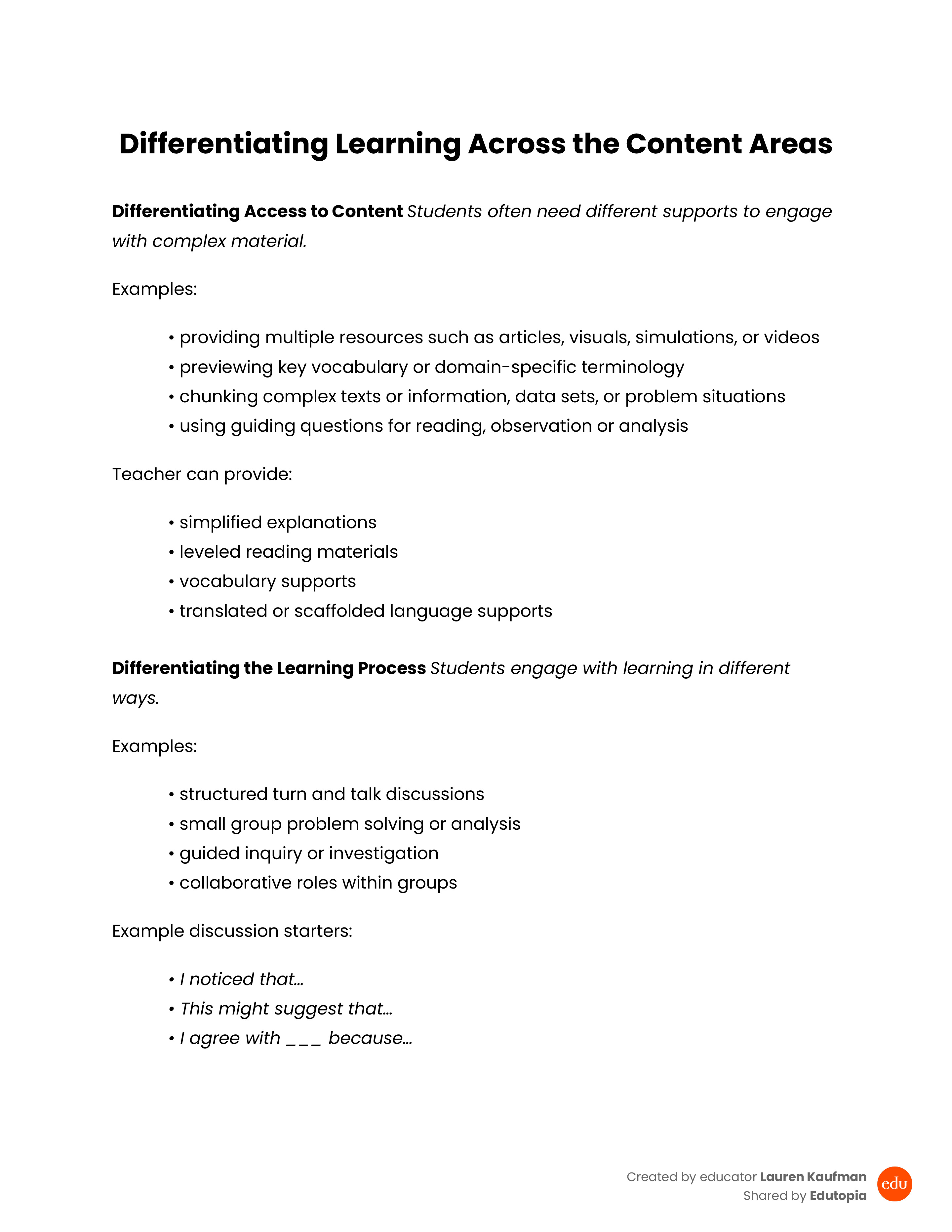
When I work alongside teachers, I often see them providing multiple pathways for students to access content such as written text, audio, video. This is one way teachers layer learning, giving students multiple entry points to build understanding over time. Students might annotate a text, sketch a visual, talk through their thinking with a partner, or use a graphic organizer. In these moments, the work becomes less about assigning different pathways and more about creating opportunities for students to take ownership of their learning.
In The Innovator’s Mindset, George Couros describes choice as a key component of learner-focused classrooms grounded in strengths-based learning. He notes that when learners have opportunities to explore content in ways that align with their preferences and interests, they are more likely to engage deeply, retain what they learn, and apply it in meaningful ways.
Dr. Katie Martin builds on this idea in Evolving Education; emphasizing choice is not about leaving everything open-ended, but about giving students meaningful decisions about what they learn, the resources they use, and how they demonstrate their understanding.
Differentiation can become manageable when teachers ask:
- Is the challenge accessing the material?
- Is it processing the information?
- Is it demonstrating understanding?
From there, teachers can make small adjustments within content, process, or product and offer students meaningful choices within those structures. A few intentional decisions can make the work both manageable and impactful in a classroom full of learners.
Because the framework focuses on instructional decisions rather than specific strategies, it can be applied across disciplines. In practice, teachers identify the learning goal and determine where students may need support with content, process, or product. From there, they design a few targeted options and invite students to make meaningful choices within those structures.
Not every student chooses from every option, and not every lesson includes all three areas. A teacher might offer two ways to access content, one or two supports for processing, and a choice in how students demonstrate understanding. In this way, choice is structured and manageable, allowing students to take ownership while the teacher maintains clarity and focus in a classroom full of learners.
Differentiation framework in action
Imagine a middle school English language arts classroom where the learning goal is to explain how a character changes in a story. Here is how a teacher could implement the differentiation framework over the course of a class period.
Content: Students might read the full chapter independently, examine a shorter excerpt that highlights the key moment of change, or listen to the text as an audiobook while following along with the written text. Teachers can offer these options and allow students to choose how they access the material based on what best supports their understanding.
Process: Students might annotate the text using different lenses, such as color coding for characterization, literary devices, or theme. They might also respond to guiding questions by completing a character development organizer or discuss the character’s actions with a partner before writing.
Product: Students might write a paragraph explaining the character’s development, create a visual timeline of the character’s journey, work in groups to annotate and synthesize their thinking on chart paper using an excerpt, or record a brief explanation describing the change.
So what does this look like in a 45-minute class period?
Before students arrive, make the options visible. You might write them on the board, display them on a slide, or print a simple one-pager for each table. The goal is that when students walk in, they can already see that today’s lesson offers more than one path.
Open by naming the learning goal clearly: We're explaining how a character changes in this story. Then walk students through the options, not as a lengthy explanation but as a quick orientation. For content, let them know they can read the full chapter, work with a shorter excerpt that focuses on the key moment of change, or listen to the audiobook while following along. For process, they might annotate, use the character development organizer, or talk through their thinking with a partner before writing. Give them a moment to decide. Some students will know immediately; others may need a nudge.
As students settle into their work, this is your window to confer. Move through the room and check in briefly, not to redirect, but to make sure each student is actually moving forward. Help one student find their place in the excerpt. Ask another what they noticed about the character’s dialogue. Pair two students who you know need to talk before they can write.
In the second half of the period, students move into product. Remind them of their options—a paragraph, a visual timeline, or a recorded explanation—and let them choose what best fits how they’re thinking about the character’s development. As they work, you shift from conferring to observing. Notice what students are producing. That information tells you where to go next.
Throughout the period, you are not running three separate lessons. You are making intentional moves within one lesson, and those moves are differentiation to personalize learning.