Books That Support Nature-Centered Play
Preschool teachers can use these books to create rich learning experiences that engage students in problem-solving.
Your content has been saved!
Go to My Saved Content.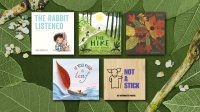
Children’s literature can open the door to nature, creativity, social and emotional learning (SEL), and movement through play. Books can grow literacy-rich experiences for learning, problem-solving, and relationships and provide a developmentally appropriate practice in preschool. Let’s explore a few play types, offering books that lead to engaging child-led experiences, connecting them with each other and the world around them.
Books That Support Creative Play
These books offer many creative adventures in nature for our early learners:
In Leaf Man, written and illustrated by Lois Ehlert, the main character is a leaf person with a maple leaf face, acorn eyes, and a spiky sweet gum fruit mouth. He leads young learners on an imaginative journey through habitats including marshes, rivers, fields, prairies, lakes, and mountains. Along the way, he passes birds, fish, and other animals, all beautifully illustrated through leaf art. Each page invites us to travel with the Leaf Man as he discovers the world around him. Using objects collected by our explorers, students can playfully create their own leaf person, animal, or object and share a short story about it.
If You Find a Leaf, written and illustrated by Aimée Sicuro, offers a similar invitation to explore and imagine. Children can slow down and use their senses and curiosity to be mindful as they seek and choose their own leaf during a leaf walk. Each example in the book invites us to use playful imagination as leaves become a boat, a leafy crown, or “anything you wish to make.” Nature’s materials become the tools for artwork and imaginative play, while offering space to ask questions, make connections, and create stories.
Both books are wonderful choices for fall, and any class leaf collection provides ongoing rich STEAM learning opportunities. Children can search, observe, sort, compare, create, and problem-solve while exploring the colors, shapes, textures, and patterns of leaves.
Not a Stick, written and illustrated by Antoinette Portis, is a perfect book for imagining what a stick can be through dramatic, cooperative, and symbolic play. After sharing this story, take the children on a mindful walk with a simple focus: Each child finds one stick. Setting a few safe boundaries, a helpful visual support might be a piece of colored paper that shows the maximum size of the stick they can choose. Children can place it on the paper to see if it fits. Remind the children that after choosing a stick, they should be sure to hold one end of the stick in one hand, with the other end pointing down to the ground when walking. Once the activities begin, model the idea that a stick becomes part of their bubble space, being safe and respectful of each other’s space.
Consider bringing a few sticks along with you, if your space doesn’t have many trees. Once everyone has a stick, it’s time for the play to begin. Here are three play activities that match well with this book:
1. Act it out. Leading with a few of the book’s statements, let each child have a turn to act out their pretend scenarios. If they’re moving, you might use the book’s prompt, “Look where you’re going with that stick.” They can reply, “This is not a stick!” Then invite the other children to guess what their friend is pretending.
2. Find a partner. Introduce descriptive vocabulary like rough and smooth, short and long, thin or thick. Allow the children to move around and find someone who has a stick with a similar trait. Try adding comparisons, like finding someone with a stick that is shorter, thicker, or smoother. This SEL activity combines relationship skills with decision-making, while developing vocabulary, listening, classification, and comparison skills.
3. Cooperative play. Invite your students to work together to build an environment, town, or habitat using the collection of sticks for small figures, such as animals, dinosaurs, or cars. Depending on your schedule, offer 30–45 minutes of uninterrupted time of free play: the first third to explore materials; the middle third to develop ideas and solve problems; and the final third to modify, clarify, and unify their group’s shared story. This gives us a chance to ask open-ended questions and guide critical thinking, while keeping their creativity unhurried. Imagination, communication, and cooperation naturally come together.
A Book for Social and Emotional Play
We’ve all experienced a fun moment that goes awry, when frustration and disappointment may surface. These moments can become meaningful opportunities for young learners to practice problem-solving, decision-making, and resilience. Rather than rushing to fix the problem, adults can create space for children to experience the challenge, explore possibilities, and discover their own solutions just by listening.
The Rabbit Listened, written and illustrated by Cori Doerrfeld, models decision-making beautifully. Dealing with a lot of big emotions, Taylor gets frustrated when his play takes an unexpected turn. His animal friends try to help in their own way, but only a rabbit takes the time to listen. Taylor then works through deciding what works best for him. This story gives students a chance to act out the plot with Taylor, showing their comprehension of what happened, while opening opportunities for understanding emotions and social connections.
A Book to Encourage Movement Play
In The Hike, written and illustrated by Alison Farrell, adventure leads friends on a hike through many shared activities, such as using a sketchbook to record observations, following directions to make a basket leaf, and reading maps to find the way. Children experience mindful moments and discoveries as their confidence grows.
Creating a map together with your class prior to the walk allows for planning and cooperative decision-making. This student-led activity empowers children to work and complete a task together while remaining flexible if the unexpected happens. It provides an engaging opportunity to invite children to choose roles that interest them, such as artists with sketchbooks, leaf collectors, or nature detectives checking off discoveries as they notice them.
When I was a child, my first task on a hike was to find the perfect walking stick: one that was comfortably sized, yet sturdy. This is a wonderful playful activity for The Hike. Students can then paint and decorate their walking sticks for future walks.
The importance of nature and importance of play are supported through research, showing that these experiences can foster children’s school readiness and well-being in early years and beyond. When we use powerful children’s literature as a framework for playful learning, we give children opportunities to move beyond the book and enter into the story. Providing time and space for cocreative learning, movement, and cooperation allows our young learners to flourish and discover the world around them while giving teachers meaningful and joyful ways to nurture the whole child.