Making Space for Science in Your Elementary Classroom
These ideas for prioritizing space—both physical and temporal—for science can help teachers give the subject the attention it deserves.
Your content has been saved!
Go to My Saved Content.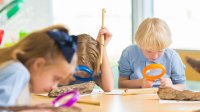
One of my elementary education students recently used the phrase “October heebie-jeebies” to describe the fatigue and pressure many educators feel as the excitement of a new school year wears off. I was thinking about this as I reflected on how science is often one of the first subjects eliminated to make room for what feels more urgent. The instructional schedule, pacing guides, and pressure for good test scores (in the current grade or later) can weigh heavily on teachers to emphasize English language arts (ELA) or math more. Some teachers also lack confidence to teach science well, particularly if they did not have strong instructional models.
Active, playful learning is hands-on, inquiry-driven, joyful, meaningful, and grounded in children’s own questions. This should be the baseline of instruction for all learners rather than something that is treated as a luxury or a reward for “finishing the important work” with time to spare. Decades of evidence on the science of learning and development (SoLD) shows us this is how humans learn deeply with gains that transfer and persist.
It is helpful to envision the teaching and learning spaces in the classroom as multidimensional: physical (the actual classroom and physical materials within it), temporal (the instructional time we have and how we allocate it), and affective (how we feel and what we believe). Paying attention to these three aspects can aid in giving science the attention it deserves.
The Physical Classroom
I’ve always envied movie classrooms, like the one in Kindergarten Cop, as they have space, furniture, and materials I only dreamed of. Establishing the physical classroom to center science teaching and learning sends a signal that science is important. If teachers do not have lots of shiny new science materials, loose parts and found or borrowed materials can go a long way.
I had a dedicated science center in my classroom stocked with magnifying glasses, scale balances, and science manipulatives—and over time, my reputation preceded me; teachers and students began bringing me shed snakeskins, fragile eggs from recent hatchings, and interesting seed pods to add to it.
I was also an avid public library patron, checking out up to 100 books per month to ensure that I had literary and informational texts related to our science focus in the classroom and available to students. A low, science-dedicated bookshelf works harder than it looks: It stores materials, its top surface becomes a workspace for pan balances and measuring tools, and repositioning it around the room can define investigation stations or create natural dividers between learning spaces.
Displaying authentic science artifacts—data charts tracked over time, written reports of findings, student-driven additions to a science word wall—signals that science is actively done in this space, not just visited occasionally. The work does not need to be visually polished to be worth displaying. This can celebrate the productive struggle inherent in inquiry and highlight students’ original contributions and efforts.
The available learning tools (e.g., science journals, investigative tools like magnifying glasses and scales) also signal that science learning happens in this space and is, at least sometimes, hands-on. For example, a teacher might create a “wonder wall,” which makes the process of scientific thinking visible and invites students to keep adding to it.
Temporal Space
Having the materials and space to support science learning does not help if we, as teachers, feel we do not have the time to teach science.
I’d argue that one of the only ways to have more authentic science instruction, as well as more time for it, is to engage in interdisciplinary instruction that crosses scheduling boundaries. In other words, science is taught during ELA and math time while we are also teaching ELA and math.
For example, I was able to observe a third-grade teacher teaching an ELA lesson on summarizing informational text. She chose a text about honeybees to incorporate science, and she had students map important themes and supporting details from the text into Lego builds as they worked in small collaborative groups.
In my own first-grade classroom, a unit on light and shadows worked similarly. Students took their science journals outside on a sunny day to trace their shadows in sidewalk chalk and then measured them using nonstandard measurements (e.g., books). We recorded the measurements across different times of the day, graphed the changes, and read and wrote about what we were noticing and why. Back inside the classroom, we explored transparency and opacity using color paddles and the classroom windows, and students created art with colored tissue paper and plastic transparencies to document what they were learning.
These are just two examples of science-related, interdisciplinary lessons that allowed for deeper learning.
The Affective Space
Making the space more conducive and the schedule more flexible, however, doesn’t resolve a teacher’s lack of confidence in teaching science. This part is harder and requires a bit more vulnerability and reflection.
Addressing the affective space requires more than one approach. Building science content knowledge helps teachers who feel less confident in the subject itself, but this rarely happens through a single workshop. When I worked as an instructional coach, I found that teachers’ confidence in science grew most reliably through sustained, side-by-side work: co-planning a unit together, modeling a lesson in their classroom, then debriefing what we both noticed.
Structures like lesson study (where a small group of teachers collaboratively plans, observes, and refines a single lesson) build both content knowledge and pedagogical confidence at the same time, because teachers are learning alongside each other rather than being told what to do. Professional learning focused specifically on managing transitions, group work, and hands-on inquiry also helps teachers feel more at ease releasing control to students, which can be a source of anxiety.
School and district leaders matter here, too. Teachers need explicit, institutional permission to slow down. A teacher who understands what SoLD tells us about how children learn deeply, but whose administrator is watching the pacing guide, is caught between two competing pressures. Leaders who understand SoLD can relieve that pressure by protecting the time that quality science instruction (and all instruction) needs. These likely all need to happen in tandem.
Teachers (and the educators who support them) do not have to overhaul everything at once. Start small, pay attention to what you are trying and how it is working, and build from there. A useful measure: If the science learning feels more engaging and real to you and your students, you are moving in the right direction.