Making Schoolwide Use of Student Surveys
Detailed feedback from students about what helps them learn can shape schools’ instructional initiatives and goals.
Your content has been saved!
Go to My Saved Content.
What if you asked your students, “What makes learning meaningful?” And how could your school collectively use the results? Grant Wiggins, coauthor of the Understanding by Design Framework, is familiar to many educators. But did you know that in 2011, he administered a survey to 7,300 students? The survey asked students about what made learning experiences meaningful.
For decades, my work has focused on promoting practices that support student agency and deeper thinking. So, I’ve asked schools I work with to conduct a survey with their students, using a variation of Wiggins’s three questions:
- What was the most meaningful learning activity you have been involved with this year, and why was it meaningful?
- When do you learn best in class?
- If you could give teachers just one piece of advice on how to make their classes and the work more interesting and effective for you and your peers, what would it be?
Students identify their grade level and describe why a learning activity was meaningful to them. Middle and high schools collect responses electronically, using tools such as SurveyMonkey or Google Docs. Upper elementary students use a separate index card for each question. Either strategy can facilitate efficient categorization of anonymous responses in analyzing patterns across the school.
COLLABORATIVELY ANALYZE RESULTS
Collaborative analysis can be both eye-opening and helpful for teachers and school leaders in setting goals for the coming school year. In preparing to review responses, I remind staff that some students will say that nothing was meaningful. Blunt comments like that can make educators feel defensive. We need to remind ourselves that when we give students a voice, we might not like what they tell us; but we can reflect on what they say and take actions to make learning more meaningful for every student.
To illustrate what you might learn from student surveys, I’ll describe specific results from one combined middle and high school in New York City that I’m working with. The analysis and resulting planned actions by this school provide an effective three-step process that any school can use with success.
Step 1: Identify the most common responses. One or two lead people can quickly skim resources and use different-colored markers (or highlighters) and color-code the common responses for survey questions one and two. Soon, several themes will emerge. This step doesn’t require the entire faculty’s time. Rather than code every response, you only need to uncover a few strong patterns. This step facilitates the creation of subgroups (in Step 2) that are tasked with analyzing each common theme in greater depth.
Analyze question one: The first part of question one provides examples of things that students found meaningful. For example, students identified things such as creating food webs, writing a research paper, theater games, doing experiments, and learning about surface area. The content area didn’t seem to matter.
The second part of question one describes the reasoning as to why a learning activity was meaningful. Identify common themes in the second part of student responses by color-coding them. These are the most frequent reasons that students in the school gave for why learning was meaningful: “accomplishing a complex task,” “learning actively,” “having real-world relevance,” and “expressing a personal voice or perspective.”
Analyze question two: Overwhelmingly, most students in grades 6–12 identified learning in small groups as the way they learned best. They stated it in different ways: “we strengthen each other’s thoughts,” “when we listen to and don’t distract each other,” “when I can learn with my friends and share the same vibe.”
Additionally, some students mentioned that they learn best when learning is fun, like a game or competition, and when learning is hands-on and active.
Step 2: Analyze common themes. The preliminary analysis of student feedback identified four common themes for the school:
- Working in groups
- Learning that is fun and interesting
- Accomplishing complex tasks
- Active hands-on learning
The faculty was randomly divided into four subgroups and given the preliminary color-coded spreadsheet (or presorted index cards) to complete the coding for one theme and examine it in greater detail.
Each group connected that theme with their own teaching experiences and responses to question three, “What advice would you give your teacher?” Interpretations for each theme were recorded using a Collaborative Commitment Tool to guide discussions. Each group identified behaviors that support and potentially act as barriers to each theme. This analysis might take one to two hours during common planning time, including sharing.
For reference, read the Collaborative Commitment Tool (below) that this school completed to analyze student feedback.
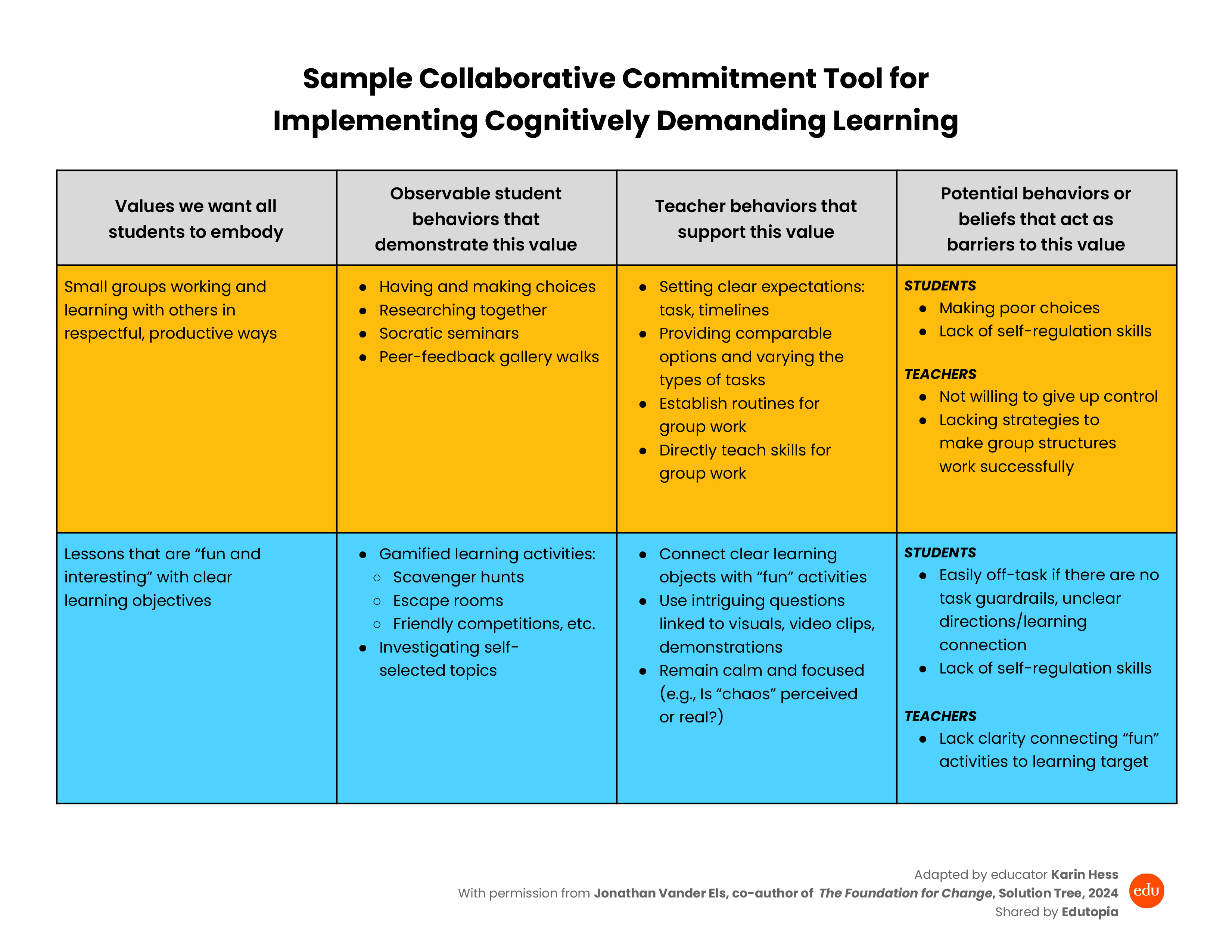
Step 3: Share analyses of common themes. Each subgroup distributes copies of their section of the tool and describes their interpretations. Add new ideas by using a Google Doc along with the tool.
COLLABORATIVELY TAKE ACTION
Once ideas have been clarified, teachers are asked to identify three things: individual strengths (things they are currently doing successfully); areas for more learning; and either as a department, grade-level team, or faculty member, state a collaborative commitment that they are ready to make to enhance student learning.
The school had three major findings:
- Students validated the ongoing work done this year to make assignments more rigorous and meaningful.
- With the principal’s support, teachers agreed to be part of regular, schoolwide “rigor” walks to document evidence of challenging material and student engagement across classrooms.
- While some teachers had been reluctant to use group work, everyone made a commitment to learn about/try more group strategies that were fun and challenging.
Although many schools wrap up the school year analyzing test data, research shows that teachers are far more likely to rely on their own communications with and observations of their students than on quizzes or test scores to determine if they had a successful school year. A student survey is an excellent way to listen to what students say they need to be successful. While this is a perfect time of year for individual teachers, school facilities, and school leaders to collaboratively evaluate the implementation of a schoolwide initiative and to plan next steps, surveys can also be administered at the beginning of the school year.