
How to Create an ‘Operational Scope and Sequence’ to Track Important Work Across Your School
A principal shares the templates for a document that her team created to aid in planning, and in tracking how and when decisions were made.
Your content has been saved!
Go to My Saved Content.
What happens here? What makes us us?
These are some of the questions that go into telling the story of a school. For school leaders and administrators, answering these questions can be an immense—even overwhelming—task.
But it doesn’t have to be so difficult. Schools can intentionally develop coherence and clarity by building detailed plans. As a principal, I’ve found that the single best way to do so is by cocreating and continuously refining an “operational scope and sequence” that breaks down the school year into its discrete elements.
Here are some tips and best practices for tweaking your own living document.
Reflect the year’s rhythms
Years ago, the administrative team and I mapped our work onto chart paper, from July to June. This was, in part, an exercise in empathy-building. Everyone constantly does so much, and I wanted to visually acknowledge our collective efforts. But this also lent the framework for the operational scope and sequence.
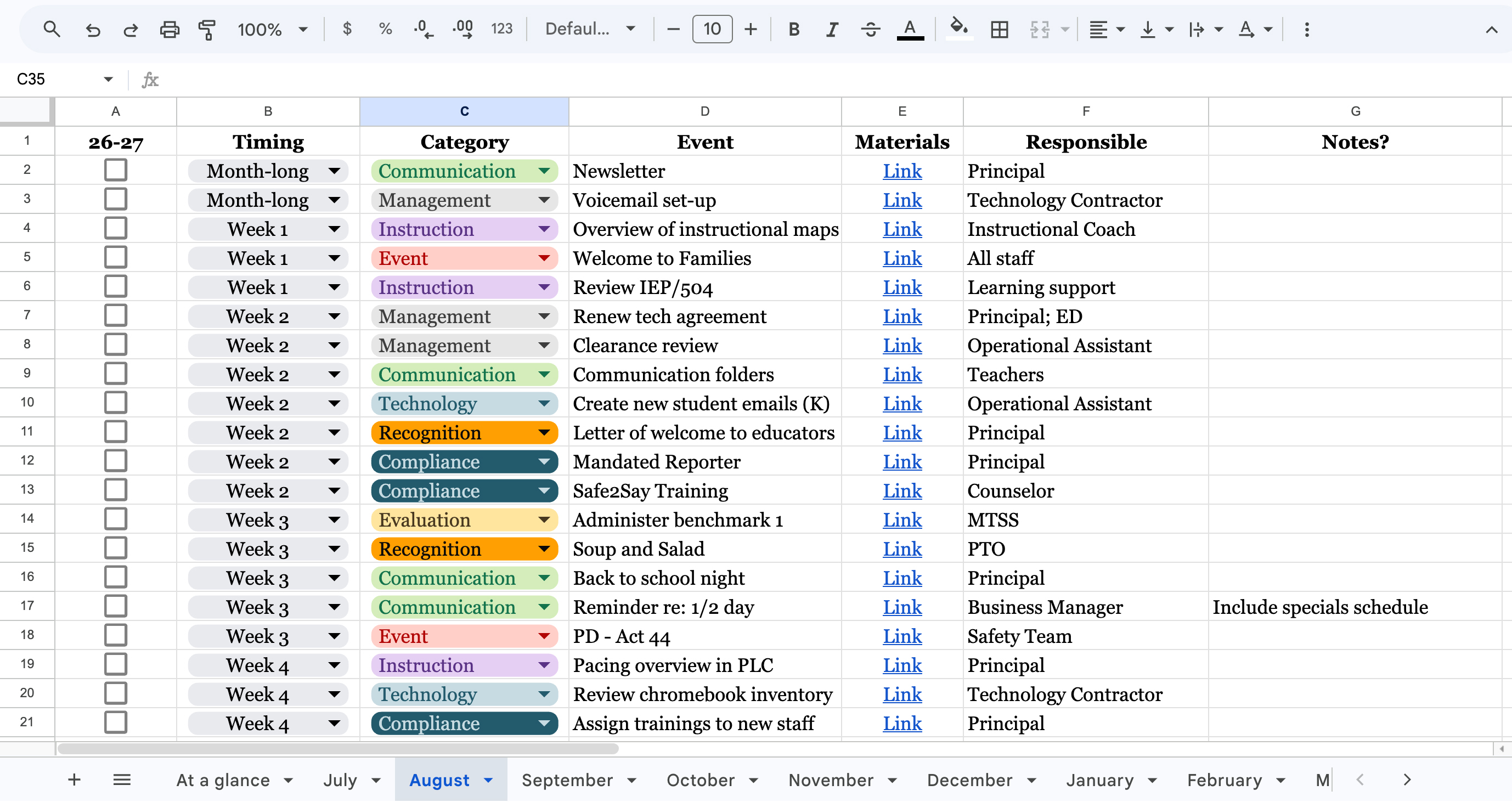
Constructed in Google Sheets, this resource lists the year (“at a glance”), has a tab for each month, and aims to capture everything we do at our school. There’s a column for each of the following:
- Timing
- Category (is this a compliance item? an evaluation? etc.)
- The event itself
- The materials that the event requires
- Who’s overseeing the event
- Additional notes
- A check mark box for after the event has been completed
Taking the resource in its totality, the operational scope and sequence grows and changes along with the school and its priorities. Powerfully, it creates an archive of our history. We can reach back in time and pull a previous flyer link or get a sense for how (and why) events evolved from one month to another. This tool grounds us as the school year picks up pace, and it helps us make sure that core components of who we are don’t get lost.
(You can make a copy of the operational scope and sequence template here or via the "download" button below.)
Make tweaks as you go along
The most important column within the operational scope and sequence is “materials,” which serves as a digital file folder for each event. Each “material” links to a Google Doc that clarifies precedent and preserves resources by including past emails, mailings, videos, spreadsheets, and the step-by-step articulation of processes.
Early on in the development of the operational scope and sequence, we inserted a simple plus-and-minus table at the top of each “materials” document. This tool for reflection supports us in understanding how expectations, procedures, and traditions have evolved, rather than just reenacting them year-over-year. I’ve found that adding a date helps track and explain changing practices over time.
(You can make a copy of the "materials" template here or via the download button below.)
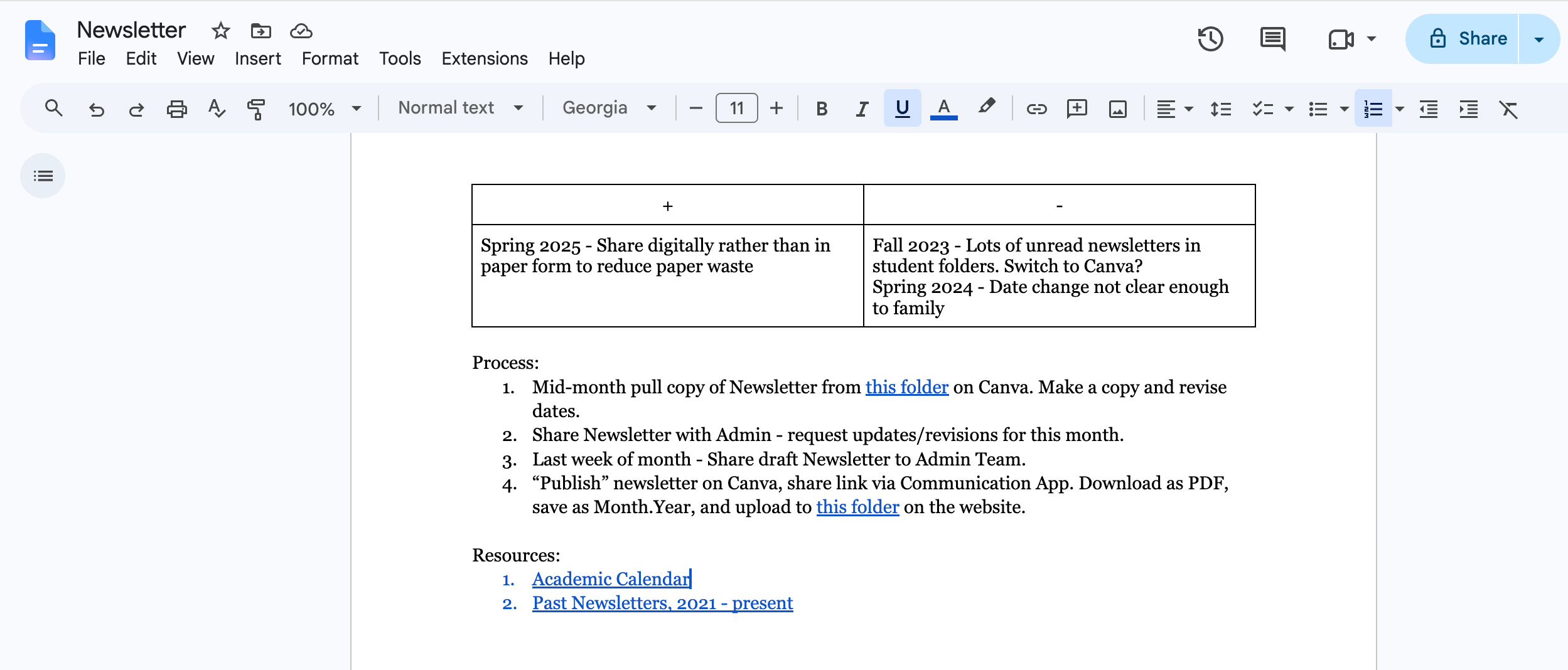
After core events take place, we add to the plus-and-minus table. This typically happens via a survey or a scheduled reflection meeting of the administration, educators, and involved stakeholders, where we debrief about an event. Insights are captured while they’re fresh, giving us the wherewithal to improve future practices. I’ve found that this strategy channels frustration into productive changes.
For example: After organizers debriefed about our five-mile walking field trip, we decided to move the following year’s event from the heat of May to the energizing month of October. It was a success!
An annual lap through
At the beginning of each summer, I retrace the year by working through the entire operational scope and sequence. I’m usually able to review two to three months per day; the whole exercise takes a week or so. I work through the materials column, making sure that key learnings are added to the plus-and-minus table. I also update hyperlinks and start to envision shifts for the coming year with the rest of my colleagues.
The time spent maintaining this spreadsheet is an act of love—a commitment to continuity, clarity, and improvement for educators, families, and students. Just as great teachers don’t simply dust off the stale resources from the year before, school leaders are responsible for refinement. And I’m always grateful to my summer self when I open a resource in March that’s already updated with dates, times, and necessary adjustments—all because of the work I front-loaded.
When I edit the operational scope and sequence, I additionally update the “at a glance” tab, which is helpful for scheduling the year ahead and organizing materials (calendars, student planners, magnets) for families and staff. The “at a glance” tab and its contents anchor our collective understanding of the core component of the school. By sharing this tab with stakeholders before the school year begins, we’re able to make sure the dates we commit to are realistic for our community. Dates are often revised, which helps us proceed in our planning and pacing with anticipation.
Using the Operational Scope and Sequence During the School Year
I start our administrative meetings by going over the operational scope and sequence for the previous month. For the most part, this means we celebrate work well done, but we also make sure we’ve fulfilled all components of the prior month by talking through the check marks on the leftmost column. If an item isn’t completed, we intentionally break it down.
For example, a teacher-generated karaoke event was once calendared, but it was left unchecked when the teacher departed. This gave us an opportunity to discuss whether to sustain the event under new leadership, skip it and come back to it the following year, or remove it from the operational scope and sequence.
Our next step at administrative meetings is planning via the ensuing month’s tab. We’re able to realistically dig into what’s ahead while considering curveballs: an impending snowstorm we couldn’t have anticipated during summer planning, or a particularly impactful flu season.
Most of the time, when we look forward item-by-item, our excitement and common purpose grows. This keeps us focused and accountable, and it also builds our collective ownership of the school.