Using Black Sticky Notes to Boost Students’ Comprehension of Literature
This innovative note-taking framework keeps students engaged when they’re approaching a new literary or historical concept.
Your content has been saved!
Go to My Saved Content.My 11th graders absolutely love using black sticky notes. No matter how old they feel walking the hallways next to the freshmen or how much they’re anticipating their senior year and beyond, the black sticky notes and metallic markers bring them back to their younger days in all the best ways.
These magical little notes serve an academic purpose, too. In the past, my historical lectures, designed to front-load context for our American literature survey course, typically received a less-than-enthusiastic response, followed by enthusiastic hand-shaking due to note-taking cramps. The front-loading didn’t work as intended, which in turn did little to help cultivate disciplinary literacy in my courses.
Then I tried out a new framework that I call PAVE: Preview, Activate, Visualize, and Encode. The PAVE framework is heavy on black sticky notes and sketching. It’s made a huge difference and improved my students’ literary comprehension, connections, and analysis.
The Basics
The PAVE framework is adaptable to a variety of academic situations, and it’s an ideal scaffold for students when they take on a literary inquiry through a new historical lens.
Preview: Students first preview key historical events, social influences, and author perspectives that tie back to a given literary movement. This independent inquiry begins as an assigned critical reading or viewing assignment, followed by listening or reading comprehension quizzes. (I like to assign videos from Annenberg Learner’s American Passages and Zubafy: Read, Write, Reason.)
For example, in advance of an introductory lesson on The Scarlet Letter, Dark Romanticism, and Nathaniel Hawthorne, students complete a critical listening assignment: They independently watch a 15-minute contextual video. They’re encouraged to take notes to prepare them for a quiz that covers elements and terms related to the video. In this instance, they might jot down notes about psychological realism, elaboration, frame, found manuscript, shame, and power.
Activate: The day after the independent previewing assignment, the class activates prior knowledge in small groups of three to five students. Terms and concepts that were introduced during the preliminary activity are displayed for all to see; in these groups, students select, discuss, and clarify the key terms and concepts, pulling from previous learnings. So, for a movement like Modernism, I might display terms and concepts like the Lost Generation, the Gilded Age, existentialism, and the New Woman movement, all of which students discuss and clarify. Through their group interactions, students begin to benefit from generative learning, which in turn promotes deep learning.
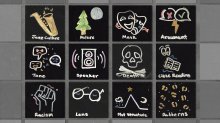
Visualization: This is where the black sticky notes come into play. Small discussion groups from the activate stage are provided with three blank sticky notes, metallic markers, and a list of relevant terms that connect to the historical context, generalized literary inquiry, author information, etc. Each group selects three terms, discusses and clarifies their meaning, and then works together to brainstorm simple icons that represent ideas. This is the visualization portion.
During a lesson on modernism and The Great Gatsby, students might represent concepts like the Jazz Age, racism, and literature of the mask by drawing icons like a saxophone, a fist, and the comedy and tragedy masks. The completed black sticky notes are added to our class collection, grouped together, and displayed on the whiteboard; this functions as a running class catalog of icons for movements spanning from American Indigenous origins to postmodernism. By the end of the academic year, we usually have quite the impressive collection.
The dual coding doesn’t end there. After group icons are added to the displayed class collection, students are asked to take a few extra minutes to do each of the following:
- Take out their personal icon library: sketchnotes with dozens of blank boxes that students fill in with icons throughout the course
- Re-create the group icons in their personal icon library
- Add four more individualized icons to their personal icon library

Through both collaboration and independent visualization, students are able to process abstract concepts, represent them in a spatial manner, and improve their synthesis: a key cognitive skill for effective literary analysis.
Encode: With a solid foundation in place, students encode, retrieve, and store information during the ensuing introductory lecture and class discussion. They do so through icon-blended, handwritten note-taking that encourages reorganization and schema connection. The note-taking is more than just transcribing; students slow down, select words and concepts, visualize those concepts, and illustrate connections by utilizing the icons that they generated collaboratively and independently.

Classroom Effects
What makes the PAVE framework effective is that it encourages deep learning and pushes students to select information, organize that information, and integrate it with prior learning. Students are then able to create learning artifacts (both the sticky notes and their personal icon libraries) that they can refer back to later in the unit, as well as the course as a whole.
Once the PAVE framework is introduced and repeated, it becomes a straightforward routine for students. Best of all, it really doesn’t take up much time, usually 10 minutes or so for the group and independent icon work. Plus, students’ growing icon libraries and conversations with peers go beyond basic, surface-level engagement. I’ve noticed that students are much more attuned to lesson concepts and enjoy trading compliments with one another about their sketches. I’ve overheard, “Wow, I didn’t know you were so good at drawing” and “Oh my gosh, that is so creative.” Sometimes, their structured notes even become fridge-worthy.
Not every student is an artist, though, and I always emphasize that they aren’t supposed to be creating Art with a capital A. Rather, I stress simplicity and symbolic connection to concepts. While phones are generally relegated to my hanging phone caddy, and laptops sleep comfortably in closed backpacks during my class, I do allow students to use devices to look up definitions and peruse possible icons that they can modify and re-create by hand. I also tell students to label their icons by hand. That way, they reinforce the connection, and everyone can have fun with black sticky notes and sketches, regardless of their artistic abilities.