
How Number Lines Can Boost Mathematical Understanding
From fractions and decimals to distance and time, the humble-but-versatile number line can deepen students’ understanding of key mathematical concepts.
Your content has been saved!
Go to My Saved Content.When a kindergartner is asked to solve the equation 7 + 6, the numbers alone don’t always make clear what they’re being asked to do: determine what number is six numbers greater than seven. To figure it out, many students are taught to rely on a familiar mental tool: the humble number line.
Number lines—a staple of early elementary math classrooms—do more than help students arrive at the right answer to the first equations they ever encounter; they help students understand why it’s the right answer. By visualizing the sequential and spatial relationships between numbers, students begin to build a mental model of how numbers relate to one another, a foundational skill that research consistently links to later math success.
A 2024 series of studies dedicated to exploring how number lines can support mathematical understanding highlights just how powerful this tool can be. Researchers found that their use in the classroom can significantly impact student learning across a range of domains—from teaching whole numbers and operations to fractions and measurement—encouraging students to “conceptualize all numbers as belonging to a unified number system.”
Drawing on classroom practices and insights from this research series, we’ve outlined five practical strategies teachers can use to support students’ understanding of critical math concepts and skills using the number line.
Build Number Sense Through Lively Debates
In Laura Berman’s second-grade class, number lines aren’t static—they are dynamic tools that students actively manipulate and center debates around.
In one lesson, Berman uses a “more open number line” to help kids understand where numbers go without providing markers as hints. She tapes a strip of paper to a whiteboard and labels one end 0 and the other 30, then hands out sticky notes labeled with the numbers 4, 8, 11, 18, 21, and 26 to her students. They’re directed to place their sticky notes wherever they think they belong on the number line, stretching out their number sense.
Then Berman asks, “Do you agree with all the numbers, or are there any that you disagree with?”—spurring debate about placement and the amount of space between numbers, and prompting students to justify their decisions and evaluate relative spacing. For example, students in one of her classes concluded that 4, 8, and 11 were too close together.
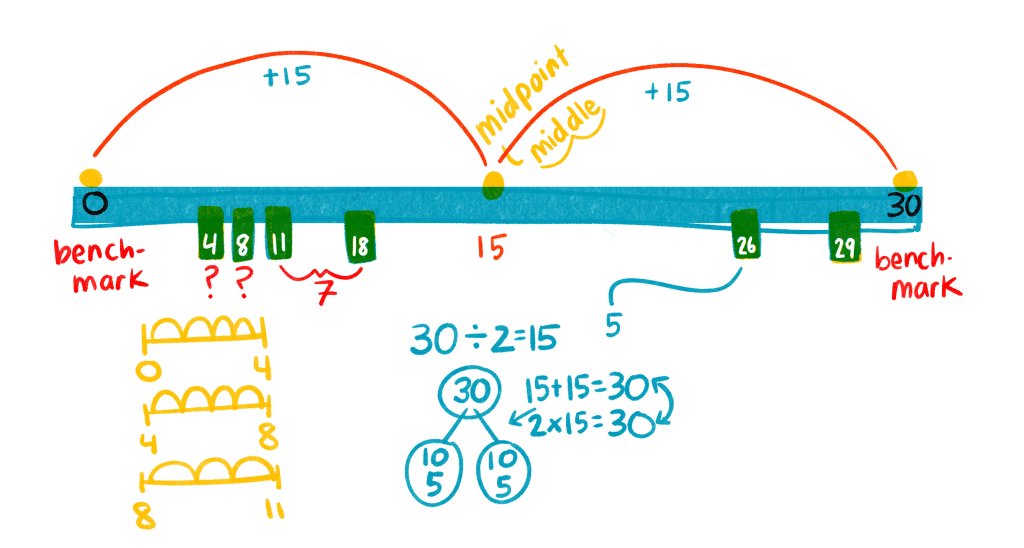
In Laura Berman’s second-grade classroom, students place numbers on an open number line, then debate their placement—strengthening their number sense.
Berman later guides students through corrections, starting with defining the midpoint of the line and the spatial relationship between 0 and 4 versus 4 and 8. Teachers in classrooms with older students can practice a similar activity using longer number lines or exploring where fractions and decimals fall on a line between 0 and 1.
Visualize Magnitude and Quantity
To help students understand the magnitude of numbers, researchers in the 2024 series recommend using a cardinality chart—which links representations of numbers (such as drawings of teddy bears) to the numerals on a number line.
A pre-K or kindergarten teacher could have students count from 1 to 10 on a cardinality chart to visualize and reinforce the magnitude of 9 relative to other numbers. As a student’s eyes drift to the right on a number line, for example, towers of teddy bears get taller, letting students see that 9 is less than 10, because it has fewer teddy bears, or that 9 is clearly one more than 8.
Turn Fractions Into Digestible Pieces
Understanding how fractions, decimals, and whole numbers relate is essential—not just for higher-level math, but for everyday tasks like cooking or careers like nursing that require precise calculations. Yet these concepts are notoriously difficult for students to grasp. In fact, students with a weak understanding of fractions and decimals are more likely to struggle with advanced math, according to a 2015 study.
A common reason that students struggle, researchers note, is because of how fractions are generally taught: Students often learn the part-whole interpretation of fractions, thinking of 1/6 as one slice of a pie divided into six parts, but less often as one-sixth of the distance from 0 to 1 on a number line. This distinction can “hinder students’ ability to think flexibly about fractions,” write the researchers of another study in the series, limiting their understanding of how fractions and decimals relate.
To help students better understand fraction magnitude, researchers suggest using number lines as a hands-on tool. In one activity, students draw a number line from 0 to 1 on a piece of paper, then fold the paper in half to mark the midpoint. Students label the fold as 1/2, and write 0/2 and 2/2 under the numbers 0 and 1—helping them see that fractions represent both equal parts of a whole and specific locations on a continuous line.
These number lines can also help students explore equivalent fractions. For example, students can draw a second line of the same length and divide it into four equal parts—making it clear that 1/2 and 2/4 are equal and fall at the same point on the number line.
Number lines also help address a common point of confusion for students: As denominators increase in value (1/2, 1/4, 1/6), the value of the fraction decreases—the opposite of what students learn with whole numbers. By placing fractions on a number line, students can better understand how they relate to each other, researchers note, building an intuitive understanding of why 1/4 is less than 1/3, which is less than 1/2.
Measure How Far? And How Long?
Number lines can also make real-world math—like distance and time—more concrete for students, becoming “a tool for solving problems with distinct units of measurement,” researchers write in another study featured in the series.
In one activity, students use a number line to solve a question requiring them to compare distances measured in two different units: Luca took his dog on a long walk around his neighborhood. When he got back, he looked at his fitness tracker. It read that they walked 3.8 kilometers (km). Luca’s friend Lily also took her dog on a walk. Lily reported that she walked 2.5 miles (mi). Who walked a farther distance?
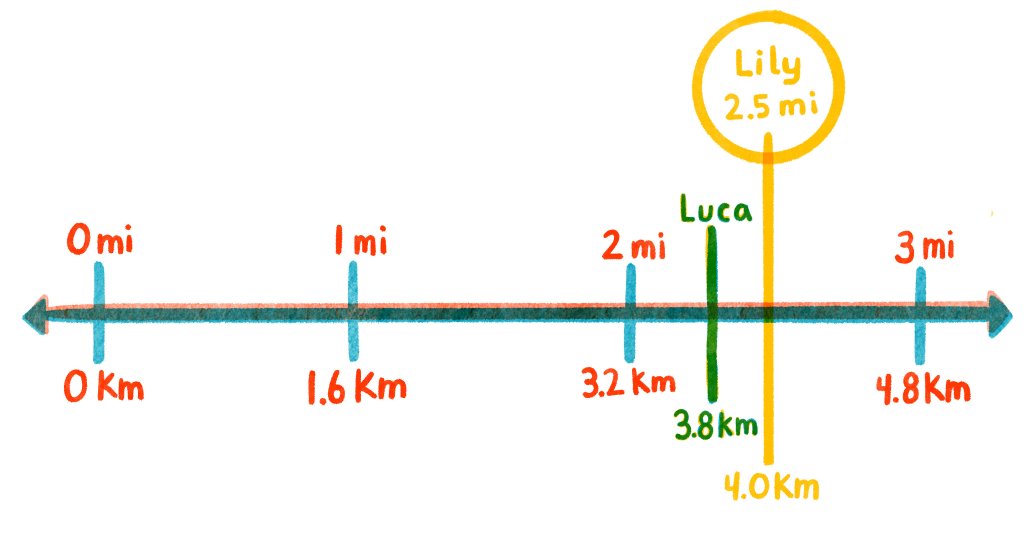
To determine who walked farther, students draw a number line labeled “miles” along the top and “kilometers” along the bottom, then partition the line into mile increments and calculate the corresponding kilometer values. By aligning the two units, they can directly compare distances while also seeing how the units of measurement relate.
Number lines are just as useful for measuring time. Given a problem like, A field trip runs from 8:30 a.m. to 1:15 p.m. How long is it? students can draw a number line and label the start and end times and break the interval into manageable chunks—such as 15-minute increments—making it easier to calculate the total elapsed time.
Help Fractions and Decimals Speak the Same Language
Similar to fractions, students’ understanding of decimals is a strong predictor of later math achievement, in part because it requires them to recognize that different notations—like fractions and decimals—can represent the same value.
Students don’t always make that connection on their own. One way to bridge the gap is to place both forms on the same number line. In the final article of the series, for example, researchers recommend giving students a decimal (0.2) and asking them to locate it on a number line partitioned into tenths to answer the question, At swim practice, Devon swam 0.2 of a mile. Mark a point on the number line to show how far Devon swam in fraction notation.
When students mark the decimal’s location and expression as a fraction on the number line, it reinforces the idea that both notations (0.2 and 2/10) represent the same magnitude, researchers note. This kind of practice mirrors what “typically achieving students do mentally as they learn new number types, expanding their mental number line”—helping students build a more integrated understanding of how number types relate and occupy the same positions along a continuum.