How to Help Students Develop a Personal Moral Compass for School
Self-awareness, personal responsibility, and problem-solving skills help students navigate school and the inevitable challenges of life.
Your content has been saved!
Go to My Saved Content.
My colleague Jonathan Kasler, affiliated with Tel-Hai Academic College in Israel, and I agree that students’ development of a personal moral compass (PMC) serves as an anchor and source of guidance in a sea of powerful influences, distractions, and temptations. As Jon notes, “Each child must set out on a personal journey that emphasizes the relevance and worth of experiencing a world where virtues are essential signposts.”
Realistically, adolescents, like adults, may have more than one moral compass. They may have one for school, one for home, one for friends, etc. These might be aligned completely or partially. Based on conversations and collaboration with Jon, I’ll address the personal moral compass for school (PMCS) because that is the one that educators can guide students to follow.
Why Focus on a PMCS?
A well-formed moral compass is an essential skill that can enable students to reach a high standard of ethical behavior (as long as they have the social and emotional skills to enact those standards). Researchers have determined that a moral compass is one of the key factors that may promote resilience in the face of trauma and also helps reduce the risk of psychiatric disorders such as posttraumatic stress.
Along with self-awareness, responsible decision-making, and problem-solving skills, developing a strong personal moral compass can help promote the goal of having confident, skilled, and moral individuals. To help prepare students for a complex and challenging world—indeed, as part of anyone’s portrait of a graduate—educators can help students form a moral compass along with the social and emotional and character development needed to thrive.
Jon says that “each child must set out on a personal journey that emphasizes the relevance and worth of experiencing a world where universal virtues are essential signposts. As they get older, the moral dilemmas that are inevitable need to be presented, modeled, and simulated to serve as essential training for real-life situations where wise decisions need to be made that are both practical and infused with the virtues with which they identify.”
The PMCS is Relevant in All Content Areas
Developing a PMCS can happen outside of a whole school commitment. Any individual teacher can raise the topic of a PMCS in their content area or in advisories because moral dilemmas and interpersonal choices arise in all contexts. Of course, anyone intending to do so should inform others in their school, so that they won’t undertake a parallel effort. Everyone can use the concept with their students for key decision-making moments in academic subject areas or in school life.
Teachers can begin by speaking with students about times when they have faced a moral dilemma, whether it involves peer pressure, confronting friends’ problematic or dangerous behavior, temptations to take shortcuts in schoolwork, or competing loyalties.
How can teachers determine which way to turn? When asked in an initial discussion what virtues or values they would consider important in addressing situations like these, students tend to name responsibility, love, perseverance, respect, kindness, courage, honesty, and family.
How to Help Students Establish Their Own PMCS
The PMCS can be likened to a navigation system. Explain to students that making decisions as an ethical person is like referring to a set of coordinates as they prepare to embark on a journey or change course on their path. In practice, students can consider key guiding virtues as they deliberate. In every academic discipline, people have faced interpersonal and professional choices, have dealt with challenges, and have had to go through a similar decision-making process.
Students can see this through the details given in novels, in biographies, or in accounts of scientific, mathematical, arts, or physical education–related accomplishments. Sometimes, they can infer it from outcomes in history or health. Students benefit from seeing these examples, which support an understanding of the importance of developing their own PMCS that they can apply intentionally in their lives.
There is, broadly speaking, a three-step process for students’ establishing a PMCS. It begins with an introduction to the concept.
First, through reading materials from the previously mentioned content areas and accounts of how various schools and trends in the visual and performing arts evolved, hold discussions about the values and virtues that different individuals/characters expressed.
Second, give students the opportunity to find out from others—first responders, clergy, school staff members, community leaders, family members—about the virtues they feel are most important in guiding their lives.
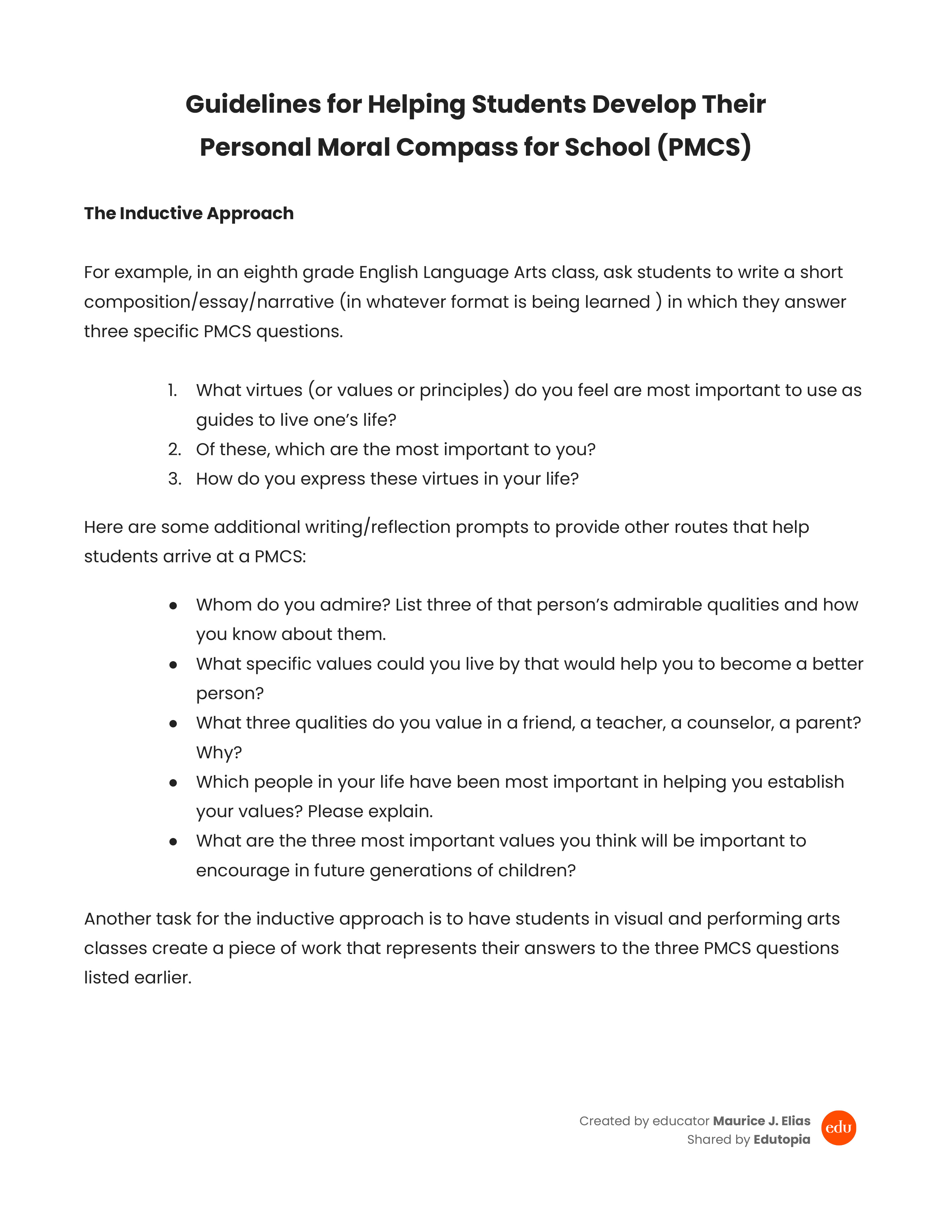
Then, students are ready for the third step: constructing their own PMCS. An inductive or hybrid approach will make the most sense, as the former gives students the most latitude in defining their PMCS; the latter builds from an accepted set of values and encourages students to add others and articulate priorities.
Try the exercises presented below to implement an inductive or hybrid approach as your students develop their PCMS.
Once students have established their PMCS, encourage them to apply it. As Jon Kasler says, “The long-term goal should be to encourage students to listen to their inner voices of their PMCS when handling real-life dilemmas and choices. Educators should make great efforts to demonstrate how acting in accordance with one’s PMCS can be crucial to help each student face and overcome the challenges that await them as they grow.”
In practice, students benefit from being reminded to use their PMCS when facing school-related dilemmas, as well as from reviewing how they might have used their PMCS to better handle situations that did not go well. Over time, they come to feel more confident and resilient because they know they have a source of guidance for handling difficult, ambiguous, or otherwise ethically challenging situations in school. This is especially valuable in a time of so many conflicting and confusing moral messages.