A Creative Strategy to Get Students Ready for Complex Texts
Before introducing something like a Shakespearean play, it’s helpful to guide students to explore other artworks with similar themes.
Your content has been saved!
Go to My Saved Content.When it comes to deeply engaging with literary content, high school students often need some kind of hook to get them started. In my experience, using a few different creative approaches has helped my students unlock themes and understand characters more fully. I have aimed to structure a process through which my students can explore content before we actually begin studying a complex text like a novel or play. I call these the four Ps: poem, painting, prose, and practice.
These are in no particular order and can be used individually or all together. I like to think of these as an extending pre-reading activity that more fully prepares students to explore a text.
USING Short PROSE TO INTRODUCE A Longer Text
To walk through the four Ps, I will use a classroom example, starting with a short piece of prose. When gearing up for the class to dive into William Shakespeare’s Macbeth, I decided to have my students first consider the myth of Icarus. This myth allowed students to begin posing important questions about ambition and what it means to “fly too high.”
While students hadn’t begun reading Macbeth, they were able to start thinking through the themes and characterizations that we would eventually see in the play.
USING POETRY TO MAKE CONNECTIONS BETWEEN TEXTS
Next, I wanted to guide my students through a poetry study to further build background for Macbeth and ensure that they felt ready for the text. We read W. H. Auden’s “Musée des Beaux Arts” and William Carlos Williams’s “Landscape With the Fall of Icarus.” Students built upon what they had already learned from the Icarus myth and made connections that prepared them for the play.
Students explored a number of questions after we completed the myth and poetry readings:
- How does the tone of the poems compare to the tone of the story?
- What is the central idea of these poems, and are they the same as the myth of Icarus and Daedalus?
- Which form engages you most and why?
I find it helpful to ask students what kind of content they find most engaging so I can continue to incorporate it into our lessons going forward.
USING PAINTINGS TO VISUALIZE CONTENT
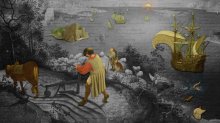
Next, we shifted gears from written words to art and explored Pieter Brueghel’s painting Landscape With the Fall of Icarus. We continued to build background knowledge and made connections between the prose, poetry, and art to create a network of ideas prepping us for Macbeth.
I particularly like bringing art into the classroom, as it offers students a completely different way to interact with our literary content. Some students who are usually less likely to engage in classroom discussions were eager to talk about art.
As we explored the painting, we discussed questions, including these:
- What do you see on the surface level?
- What can the surface level mean on a deeper level?
- Where are the figures facing, and what do you think that means?
- How does the painting connect to the myths and poetry—are the messages the same? Why or why not?
After going through these three rounds of building background knowledge through prose, poetry, and painting, students had already learned so much about Macbeth before we even began reading it.
PRACTICING USING CREATIVITY TO EXPLORE A Text
The final P in this structure is where students get to put their creativity into practice. Students have already explored prose, poetry, and painting, and now they have the opportunity to creatively express their own interpretation of the content.
In this phase, I give students the option to create their own version of a short story, poem, or piece of art related to the content and then be prepared to explain their thinking and how it relates to what we’ve studied.
In our Macbeth unit, I gave students the following creative options:
1. Translating any of the poems or prose read into their language, using current slang and idioms.
2. Introducing a new character in the myth of Icarus and Daedalus or creating a new exchange of dialogue between the father and the son.
3. Using Landscape of the Fall of Icarus as a springboard to create their own collage following the themes of the painting.
Not only are students continuing to make important literary connections, but they get to show their creativity, something that is often overlooked in classrooms.
Once we got into Macbeth, students would bring up their “aha” moments, realizing why they had studied those previous forms of artistic expression. It’s even more fun and engaging when my students naturally make connections to other paintings, songs, stories, and poems that they’ve seen outside of our classroom.
By going through this process of exploration, students gain a broader perspective of the main themes of the upcoming text. As a class, we have the opportunity to engage in meaningful, engaging conversations that ask students to look at things through a creative lens. By the time we get to the main text, students are excited for it and feel ready for the work ahead.
When getting started with this process in your own classroom, it can be helpful to do some basic online searching to help you identify examples of prose, poetry, and paintings that would align with the major text for your upcoming unit.