Fun End-of-Year Assessments for Art Classes
Teacher can try incorporating scavenger hunts and a Pictionary-style tournament to get students to show what they know.
Your content has been saved!
Go to My Saved Content.
Schools across the U.S. are weathering the seemingly endless days of state-mandated standardized tests, so I wanted to share some ways to assess student learning and add some fun into the classroom that don’t involve clicking multiple-choice answers or reading “passages.”
As an art teacher, I often run up against the assumption that my class is “loosey-goosey,” that it must be “so easy” because students aren’t writing papers or solving complex mathematical problems (and of course, because there is no high-stakes test for art). However, assessment is one of the most important aspects of creating a successful and impactful art experience for the young people who walk through my classroom doors every day.
Building Deeper Engagement Through Scavenger Hunts
A deep understanding of art requires context, vocabulary, and concrete skills as well as an ability to closely observe and analyze images. These skills help students when they are developing their own compositions and experimenting with various mediums. One of the challenges in the art room is finding ways to challenge young people to slow down and look closely. Putting an image up on the board to discuss works for quick analyses and larger class conversations, but those activities don’t invite that close look or provide an opportunity to slow down. Similarly, providing printed images to students to observe doesn’t necessarily or automatically lead to close observation and analysis either.
This school year, I really wanted my students to engage with various works that introduce and reinforce composition principles and techniques. I also wanted to help them see relationships between those works and artists. I knew this meant that I needed to give them an incentive to look closely, and I wanted them to build connections across a collection of works. I decided to create a scavenger hunt for our block-printing unit that would give them a variety of prints to look at, which incorporated a variety of styles and approaches and introduced vocabulary that we would be using throughout the unit.
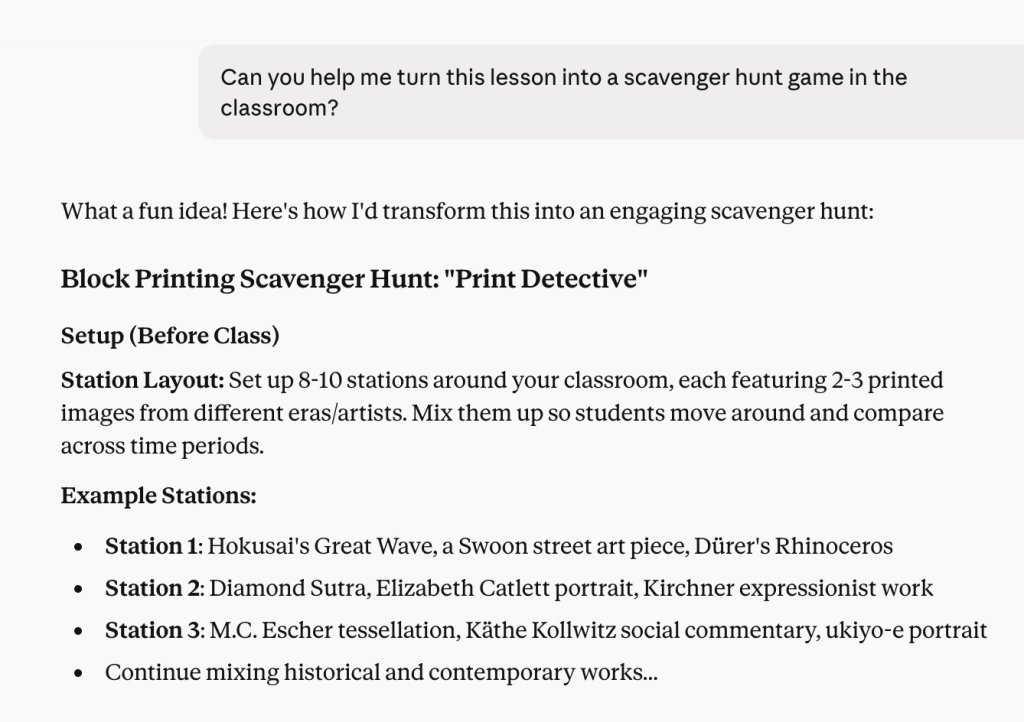
I collaborated with Claude to help identify a collection of works and to help develop the questions by uploading my unit plan so that the questions were directly connected to the unit’s vocabulary, skills, and enduring understandings. I printed the artwork in “stations” with questions where the correct answer was linked to a letter. If students got the right answer, they could assemble the letters into the “secret word.” Claude helped assign letters to the correct answers so I didn’t need to do it by hand. I gave each student a blank scavenger hunt list, and they had the entire period to complete it. The first five students with a complete and correct scavenger hunt earned a snack.

Once I gave the directions, I sat back to watch students move from station to station in no particular order, read the questions, get closer to the image, and decide on an answer. I didn’t allow them to work in teams, to ensure that each student took responsibility for observing and analyzing the artwork. I could immediately see a level of engagement with the images that wouldn’t have occurred by just giving them an image to observe without the added layer of competition and challenge and time constraints.
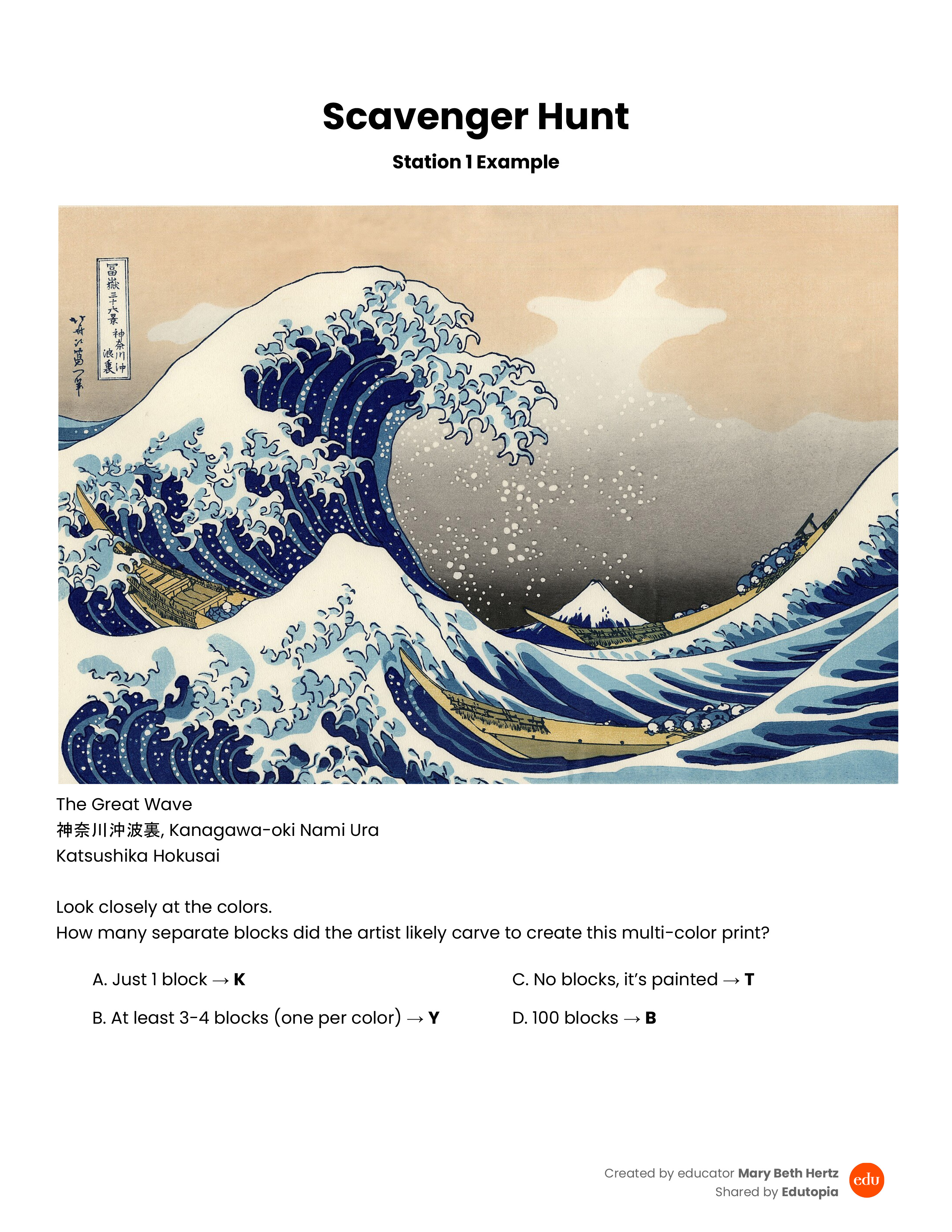
While I tend to use scavenger hunts as a way to introduce a new unit, they could also be used to assess student knowledge at the end of the unit. For instance, the scavenger hunt for our Flat to Form unit—where students create a pastel drawing and choose an element of the drawing to build with wire and cardboard—requires them to write down specific lines and techniques that they notice in the work. Doing this demonstrates their understanding of layering, mark-making, and composition principles.
Creating A Joyful Space With Pictionary Classroom
The art room can have many parallels to the math classroom—students walk into the classroom having already decided whether they are an artist or a “math person.” Part of our job as educators is to help scaffold, provide adequate opportunities for low-stakes practice, give actionable feedback, and celebrate students’ successes.
I spend a lot of time in the beginning of the year instilling confidence and creating a safe space for students to make art. The more low-stakes opportunities I can create, specifically around drawing, the better. Sometimes this means marking attempts complete/incomplete rather than assessing them for accuracy or focusing on the message rather than the accuracy of the drawing. Other times it means rounds of feedback before the final drawing, and sometimes you just have to sneak a drawing lesson into a game to build confidence, lower the stakes, and provide a reference point for how drawings tell stories.
The week before spring break often has the same vibe as the last few weeks of school. To help redirect that vacation-mode energy this year, I ran a Pictionary bracket tournament.
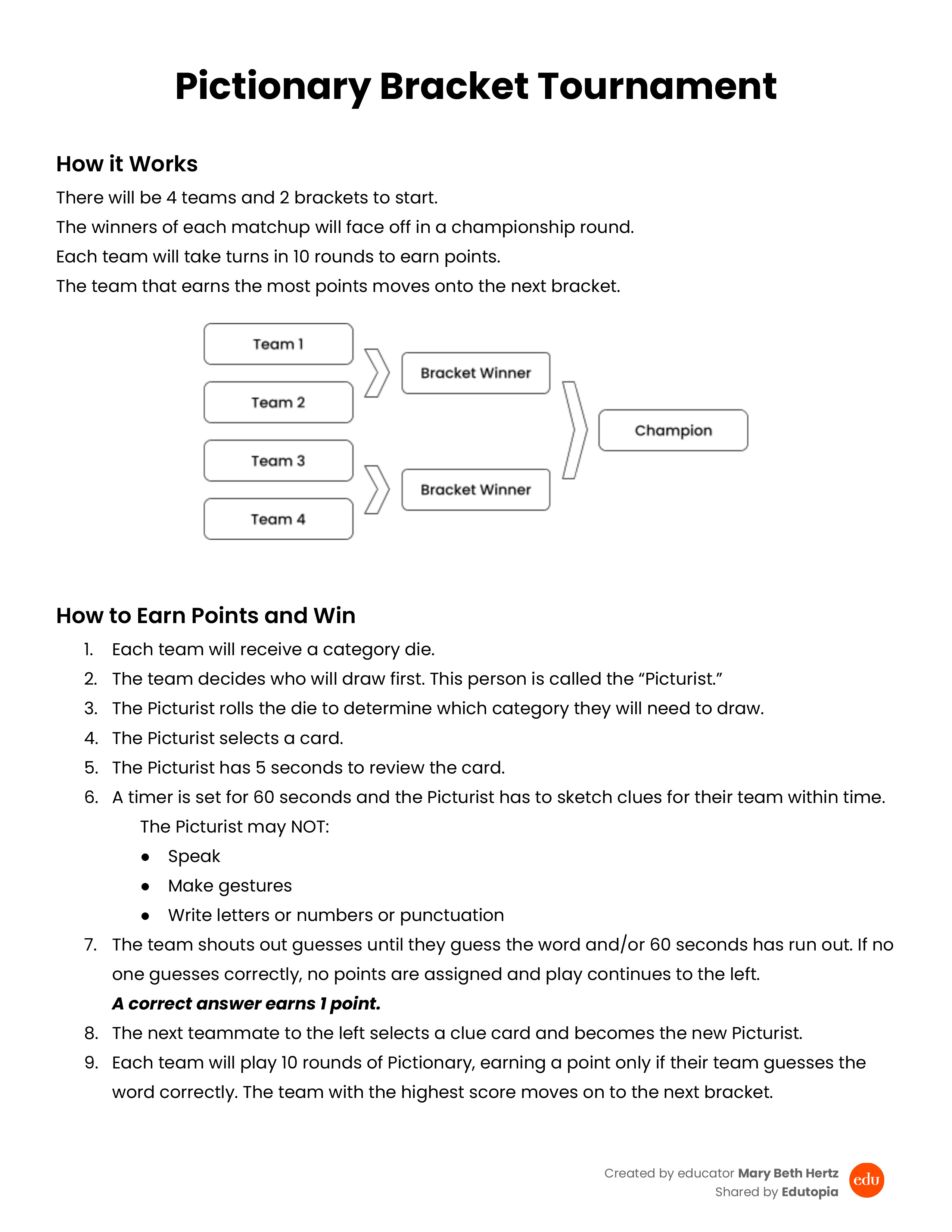
Students split themselves into four teams of no more than four students, with a neutral student referee to keep points for each team. I collaborated with Claude again to create Pictionary cards that I printed on card stock. Each team played 10 rounds, rotating “picturists” and earning points for each correctly guessed drawing, with the referee keeping score. The two teams with the most points faced off in a championship round.
Each student had to be the “picturist” at one point, and because there was an incentive to guess correctly, students got creative and experimented with their drawings. They needed to figure out how to adjust their strategy so that their team could answer quickly, and they had a lot of fun!
As we close out the school year, these are the kinds of activities that can bring joy into the classroom while also reinforcing skills and concepts. In a different content area, you could make cards specific to a unit or content area as review. The art room is both a unique space and a space just like any other classroom. Prioritizing fun and finding ways to assess student understanding in joyful ways can create a positive atmosphere at any time of the year, but especially in these last few weeks.