Can AI Pass as Shakespeare? Let Students Be the Judge
By prompting an AI chatbot to craft a Shakespearean sonnet, then auditing its fidelity to the form, students get a crash course in close reading (and a healthy dose of AI skepticism).
Your content has been saved!
Go to My Saved Content.Ask any AI chatbot to write a Shakespearean sonnet, and it will produce 14 lines’ worth of text in seconds. While this output may sound like it could have been written by Shakespeare himself, would the bot actually honor and follow the structure of a Shakespearean sonnet?
That is what my middle and high school students decide in this single-period activity.
MY MOST EXCITING (AND FRUSTRATING) UNIT
If you are a middle or high school English language arts teacher, you probably have taught at least one Shakespearean play in your career. One of the most exciting (and frustrating) units that I teach in my classic and advanced eighth-grade classes is William Shakespeare’s Julius Caesar. Trying to get buy-in from the class can be difficult at best, and impossible at worst. The structure and nuanced language are often unfamiliar to students, which can make it feel out of reach. I use this activity to build engagement while introducing Shakespearean language and concepts to my classes.
My main objective in this lesson is to help students read carefully and analytically while applying the core traits of a Shakespearean sonnet. Though this activity utilizes technology and AI, my students generally use paper and pencil for anything that requires deep critical thinking and analysis. In our one-to-one iPad environment, where screen time can feel constant, I feel that intentional breaks from technology are necessary.
‘THOUGH THIS BE MADNESS, YET THERE IS METHOD IN ’T’—HAMLET, ACT 2, SCENE 2
I begin this lesson with a few minutes of direct instruction, using a Google Slide deck to introduce the different types of sonnets (Petrarchan, Shakespearean, Spencerian). I ask students only to copy the specific traits of the Shakespearean sonnets into their notes for reference, since we’re primarily focusing on them for this lesson. While all sonnets have 14 lines, Shakespearean sonnets have the following characteristics:
- They are structured into three quatrains and a closing couplet.
- They follow the ABAB CDCD EFEF GG rhyme scheme.
- They use iambic pentameter, alternating between unstressed and stressed syllables.
- They feature a volta in the final couplet.
Once students have their notes, I begin to frame Shakespeare as the original pop icon—someone who wrote about real issues of the time for everyday people. “If he were in middle school today,” I explain, “his work would address the daily realities of student life. In that same spirit, we too will experiment with being modern-day Shakespeares by using technology to write our own Shakespearean poetry.”
As a whole group, we begin to brainstorm common challenges that students face each day. I act as scribe, writing each idea up on the board, where they remain until the end of class. At first, responses are quite general: “school” or “parents.” But within three to five minutes of brainstorming, students get much more specific. “School” turns into “My English teacher calls on me too much,” and “parents” turns into “I was grounded on Friday night.” When the list feels ready, the students take a moment to review it, then turn to their elbow partner and discuss the one or two ideas that really resonate with them.
Once every student chooses one or two items from the list, I ask them to take out their iPads and pull up Google Gemini (though any AI platform that your school approves will work for this activity). Students will prompt the chatbot to write a Shakespearean sonnet based on the topic of their choice. They are allowed to request up to two sonnets if they are torn between topics, but capping it at two keeps them focused and on task.
Normally I work with students to craft an AI prompt, but for this lesson, I let them request the sonnet however they want. I do this for two reasons:
- First, it allows me to assess their levels of AI savviness and gauge how frequently they interact with this technology. When a student is highly savvy, this tells me that I might need to pay closer attention to their drafts, their author’s voice, and their writing structure to ensure that they’re not having AI “help” on their essays. It isn’t a foolproof method, but it provides one more piece of valuable data that can inform conversations around academic honesty and integrity, should they need to happen.
- The second reason relates more closely to the actual activity. By allowing students to craft their own prompts, there is a much greater likelihood of them receiving an imperfect sonnet. This allows for deeper conversations at the end of the activity. Either way, the activity works regardless of the AI output. If what the chatbot produces appears to be a perfect Shakespearean sonnet, students will still need to explain why they think the output is perfect. And if it’s not a true Shakespearean sonnet, students have to explain what’s wrong with it.
While students are prompting AI for their sonnets, I use ChatGPT to request a sonnet that I will use as my model for analysis. My ChatGPT is fine-tuned to function as a teaching assistant, so when I ask for a Shakespearean sonnet that my students can analyze, my chatbot produces one that has a few errors. I like to have the whole class practice analyzing my AI-created Shakespearean sonnet together first, which establishes clear expectations for what their own analysis should look like.

‘STRONG REASONS MAKE STRONG ACTIONS’—KING JOHN, ACT 3, SCENE 4
Once students have a sonnet on their devices, I distribute a worksheet to guide their analysis. You can print this out for students or have them complete it digitally. I then go one of two routes with this activity, from here (which honestly depends on the class and how on-task they are that day).
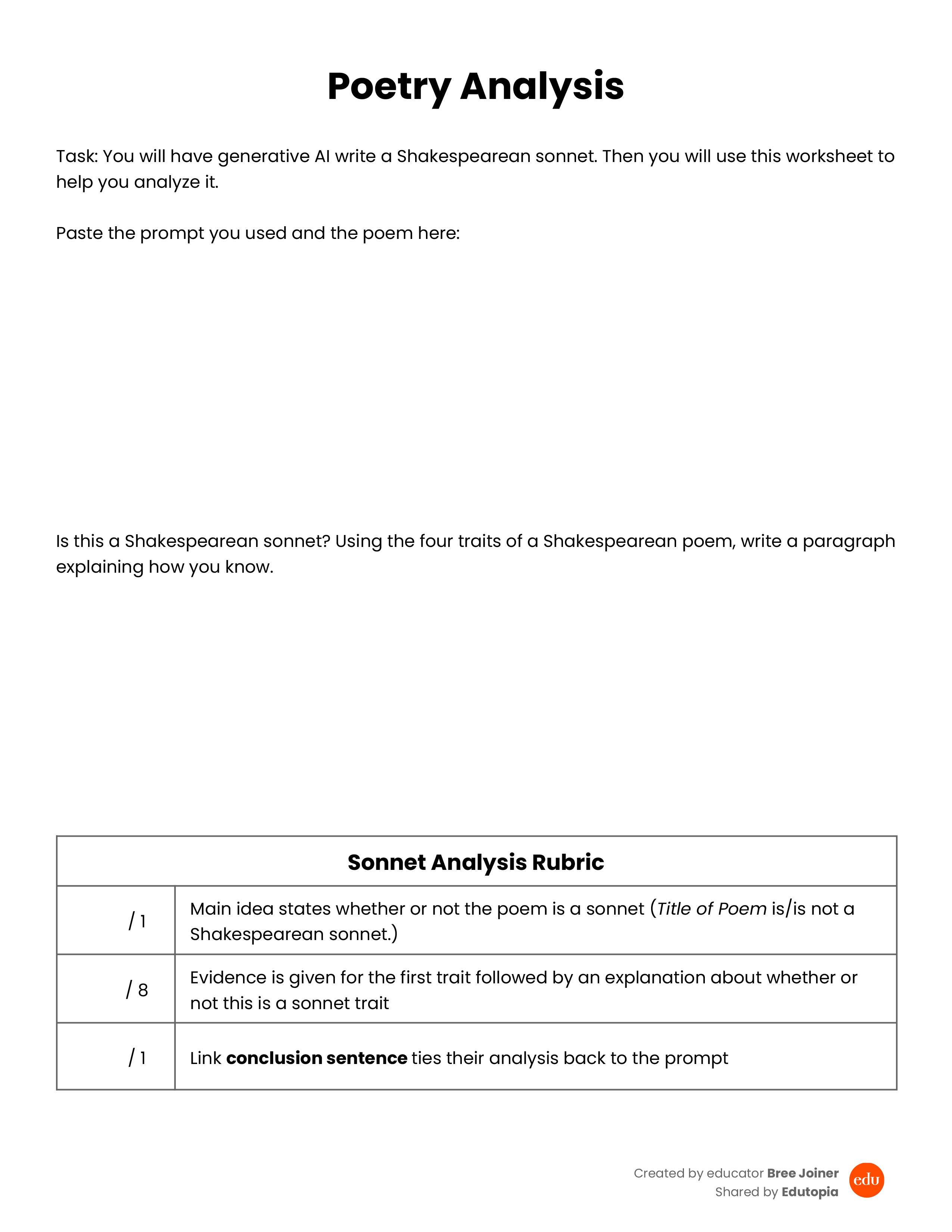
- The first route is, they can either write down the AI-produced sonnet on a piece of paper or copy it into a document. Each individual student then analyzes their own unique poem, using text evidence to support their claim on whether or not it qualifies as a true Shakespearean sonnet. This adds a layer of complexity to grading because students are all reviewing something different; however, it also enables greater student buy-in to the task.
- Alternatively, students can submit their AI sonnets to me via our learning management system (or Google Classroom), and one is selected for the entire class. This option allows for each student to still analyze independently, but it makes grading more uniform.
Before students move to the analysis portion, I model this process. On the board, I walk the class through how to structure their written analysis paragraph, emphasizing the need to incorporate evidence from the poem to support their claims. For example, does the sonnet possess the correct rhyme scheme? One student, analyzing the rhyme scheme of his sonnet, wrote: “The first stanza has the rhymes ‘rest,’ ‘due,’ ‘test,’ and ‘view.’ This rhyme carries on throughout the sonnet and ends with the words ‘same’ and ‘flame.’” From here, students work either independently or in pairs to determine if their sonnet is a true Shakespearean sonnet possessing all of the traits. I leave my example analysis on the board for reference. Frequently, my developing writers will model their work very closely to mine.
As a wrap-up to this lesson, I will have students volunteer (or I’ll volun-tell them) to read their sonnet aloud and explain why they think it is or isn’t a true Shakespearean sonnet. If a student struggles to analyze the sonnet well, I allow other students to raise their hands and contribute their own thoughts. My students enjoy this activity for a few reasons. Naturally, this process helps them begin to understand the structure of Shakespearean language, but they really enjoy reading “someone” else’s sonnet. They frequently comment on how relatable the sonnets are to their lives—and ultimately isn’t that who Shakespeare was, a man for all generations?