Is Your Assignment Vulnerable to AI?
Instead of starting with the question ‘can AI do this?,’ it may be more helpful to ask, ‘What thinking is required of students?’
Your content has been saved!
Go to My Saved Content.
It’s normal to be reactive when something sudden and unexpected occurs. Many of us felt that way during the recent pandemic, when we were forced to quickly react and create online and distance learning environments to maintain our educational programs. Artificial intelligence (AI) is no different (in some ways), in that it has quickly grown to dominate the educational conversations that many of us are having. Teachers are rushing to adjust to concerns about cheating, academic integrity, and how AI use is affecting how students learn and what they are learning in general. As a result, many schools are searching for “AI-proof” assessments. However, the search for that solution may be misguided.
I believe we need to accept that no task, assessment, or work we design for students is completely safe from AI. As we have seen, AI capabilities continue to evolve, with new knowledge and tools being quickly integrated into it. AI will continue to advance, and as such, it’s important for teachers to work in a deeper and honest way so that they can critically reflect about the current effectiveness of their learning task.
When we do so, we can create tasks and assessments that both support student learning and anticipate the continuing progression and development of AI. There is no such thing as an AI-proof task; there is only a spectrum of vulnerability. Our goal, as educators, is to reduce that vulnerability through better task-design.
The Vulnerability Spectrum
AI can touch every task in front of students—essays, presentations, research, posters, and summaries. However, not all these tasks are equally vulnerable, and it’s important that we know the extent to which they are. These tasks lie on a spectrum: highly vulnerable, somewhat vulnerable, and more AI-resilient.
For example, a written task that requires a student to explain the water cycle might be more vulnerable than asking students to develop a water conservation policy recommendation that cites multiple sources. Asking students to analyze climate data you give them is more vulnerable than conducting an interview with experts in the field. Note that even here, these tasks aren’t AI-proof.
As you examine these sorts of tasks, don’t ask, “Can AI do this?”—instead ask, “What thinking is required of students?”
An AI-Vulnerability Assessment for Learning Tasks
Here is an activity that educators can use as they create tasks to deepen students’ thinking learning:
- Gather a collection of common or actual learning tasks.
- Sort them on the vulnerability spectrum as “Highly Vulnerable,” “Somewhat Vulnerable,” or “More AI-Resilient.”
- Discuss your rationales, and engage in open dialogue and healthy debate to further understand the vulnerability of the tasks shared.
- Set goals for improvement or adjustments for specific tasks.
The goal is not to gain consensus. Instead, it’s about surfacing questions such as the following:
What are we actually assessing?
Where is student thinking visible?
What makes a task vulnerable?
What evidence of learning matters most?
When I’ve engaged educators in this activity, they often discover that many tasks emphasize completion over thinking. Immediately, they discuss design and improvements rather than policing or compliance techniques. Overall, the conversation shifts from worrying about AI to student demonstration of learning.
Another factor to consider is the power of the learning criteria, rubric, or other assessment tool that articulates specific requirements.
Upgrading Tasks With the A.I.M. Framework
I apologize in advance for introducing another acronym in the already oversaturated world of education. However, this framework (A: authenticity, I: intellectual demand, M: metacognition) can help teams redesign tasks once they determine how vulnerable the tasks are to AI-generated responses.
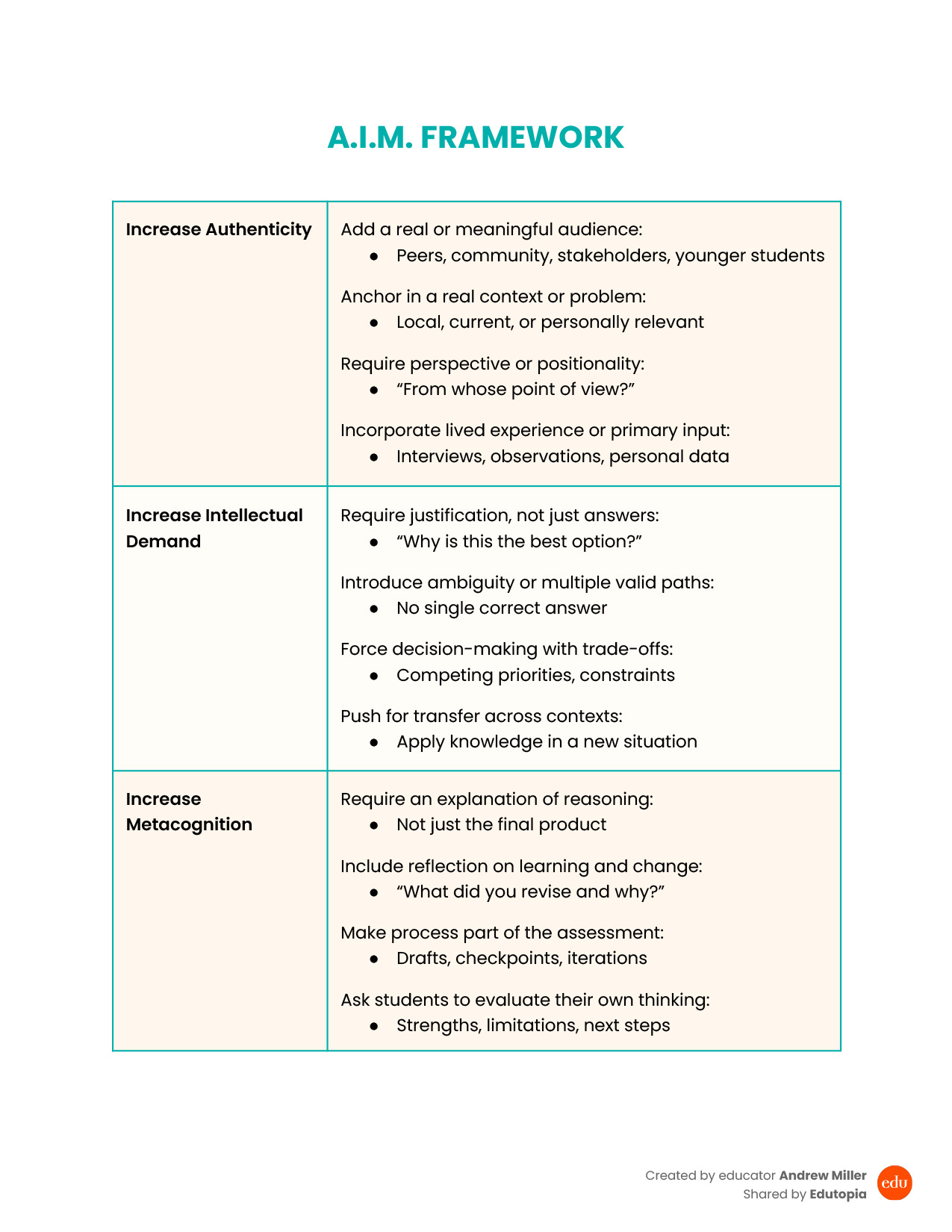
Here are design questions to consider as well as possible strategies for implementation.
Authenticity: How can I make this task more authentic and real-world oriented?
- Include real audiences in process and product.
- Connect to more local issues.
- Include student voice and personal experiences.
- Gather original information and primary sources (interviews, field research, etc.).
Example: Instead of an essay on climate change, augment it to have students develop a recommendation for your local community.
Intellectual demand: How can I increase the rigor in student thinking?
- Require justification and critical evidence.
- Examine trade-offs and competing priorities.
- Provide multiple solutions and multiple perspectives.
- Identify limitations of incomplete information.
Example: Rather than explaining a historical event, ask students to prioritize the likely causes and defend the one that they believe is most significant.
Metacognition: How can I make thinking more visible?
- Build in reflection to see how students’ learning shifted throughout the assignment.
- Describe the decision-making process/how they arrived at an idea.
- Ask students to self-assess their thought process.
- Analyze AI's role in contributing to students' learning (if applicable… at the teacher’s discretion, AI tools can be used in some instances).
Example: Develop a final essay through two drafts with a reflection where students explain how their thinking evolved.
From Surveillance to Design
For educators, it’s crucial for us to maintain our focus on better design, not better surveillance. Surveillance emphasizes a punitive, antagonistic approach, while design promotes teacher ownership of student learning and requires educators to reflect on their practice and how to adjust. Through better design, we can increase authentic learning, make learning more visible, and promote student engagement. Instead of asking ourselves, “How do we stop our students from using AI?” we can ask, “How do we design learning experiences that require students to think in ways that matter?”
If we’re being honest, AI isn’t creating new problems, it’s exposing existing ones. Artificial intelligence is giving us an opportunity to improve learning through intentional redesign of assignments for deeper and transferable learning.