Arts-Integrated Outdoor Lessons for Elementary Students
A pumpkin can become an entire unit if you let it: These engaging fall activities encourage students to slow down and learn from what’s around them.
Your content has been saved!
Go to My Saved Content.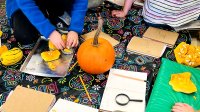
October is one of my favorite times to take learning outside.
There is so much already happening in the environment that we really do not need to create an elaborate setup. Leaves are changing, seed pods are drying out, sticks and pine cones are everywhere, and pumpkins are suddenly easy to find. I have found that these ordinary seasonal materials can lead to some of the richest learning experiences because students are able to observe, move, touch, collect, build, draw, measure, and ask questions all within the same lesson.
Here are three October investigations I have found especially easy to adapt across K–5.
1. Collect, Sort, Graph, Create
One of the simplest ways I begin is by taking students outside and asking them to collect fallen natural materials. Depending on the space, that might include leaves, sticks, stones, grasses, pine cones, bark, seed pods, or acorns. With a full class outside, I keep expectations simple: clear boundaries, a designated gathering spot, and partners or small groups. I also keep the exploration area manageable. Even a small outdoor space gives students plenty to observe and discover. Before they collect anything, I ask them to slow down and notice the following:
- What colors are repeating?
- What feels smooth or rough?
- What is tiny, curved, symmetrical, brittle, or soft?
That short pause changes the experience. Instead of rushing to grab objects, students begin looking more closely.
Once we have our collections, the math connections happen very naturally. Younger students can sort by color, shape, size, or texture. They can count and compare groups. Older elementary students can measure objects, create graphs, look for patterns, or develop questions based on what they collected.
Then I shift the same materials into artmaking.
Students might create temporary land art, repeating patterns, radial designs, sculptures, or collaborative arrangements. I love this part because the vocabulary starts crossing disciplines almost without our forcing it.
I also like ending with one very simple reflection: What did you notice once you slowed down that you did not see at first?
Sometimes the answers to that question tell me more about the learning than the finished product does.
2. Building With Nature
Sticks are one of my favorite open-ended materials because students almost immediately begin problem-solving. A pile of sticks can become a sculpture, a shelter, a woven structure, a bridge, or the beginning of a map.
I start with a question rather than a model:
- Can you make this stand without glue?
- How can two sticks connect?
- What makes a structure stable?
- What happens if you weave yarn, grasses, or natural fibers between branches?
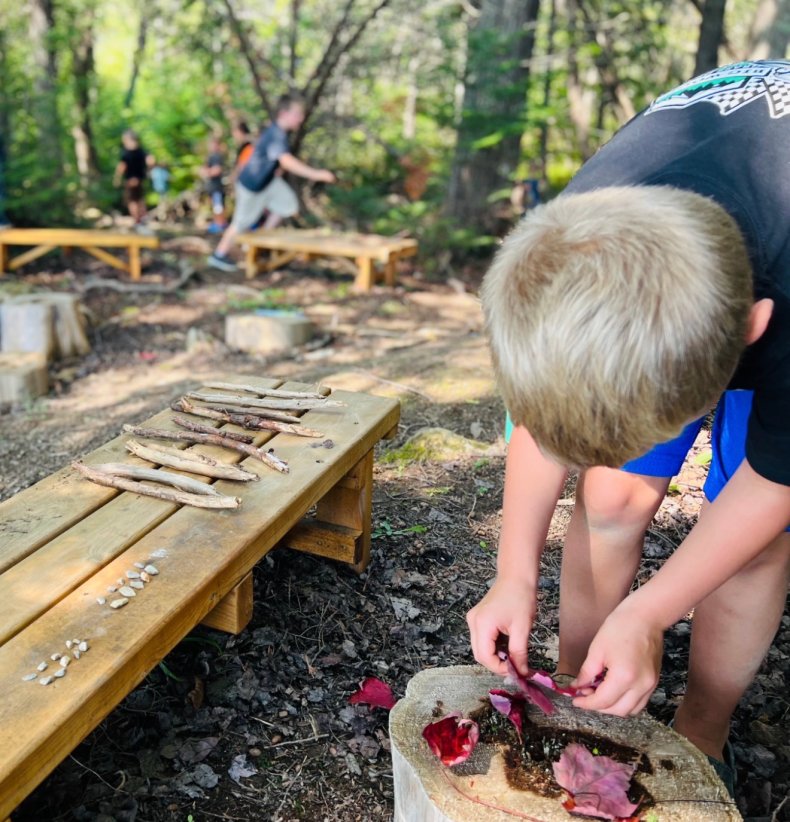
Ahead of time, I gather a few simple materials: sticks or small branches, yarn or twine cut into manageable lengths, scissors, clipboards, paper, and pencils. If natural materials are limited in the outdoor space, I also bring a small collection of leaves, grasses, seed pods, or pine cones for students to use. Young students might build miniature homes or shelters. Older elementary students can explore more complex structures, weaving, balance, or collaborative construction.
Science and math are already there. Students are thinking about shape, length, geometry, force, stability, materials, and scale. But the art is still central because they are also making decisions about form, texture, line, space, composition, and craftsmanship.
From there, I like to move into mapping. Students can draw the outdoor space where they are working and include pathways, trees, buildings, gardens, rocks, or other landmarks.
That creates an easy connection to history:
- Who uses this place?
- How has it changed?
- Who cared for this land before us?
With younger students, these can be very simple conversations about community and place. With older elementary students, they can grow into conversations about local history, Indigenous place names, land use, or changes in the environment.
3. The Life of a Pumpkin
A pumpkin can become an entire unit if you let it.
I like to begin by putting several pumpkins or gourds together and asking students to observe them before we cut, measure, or create anything:
- What do you notice about the color?
- How are the shapes different?
- Which one looks heavier?
- What textures can you see?
Students can draw them from observation and then move into measurement. Depending on grade level, they might compare height, circumference, weight, or number of seeds. They can estimate first and then check their predictions.
With students in third grade and above, I do allow them to help cut the pumpkin with clear safety guidelines and close supervision. We review how to hold and use tools safely, work in small groups, and take turns. With younger students, I do the cutting while they observe and help scoop, sort, and investigate what is inside. When we cut a pumpkin open, the science becomes immediate.
Students can examine the seeds, fibers, flesh, skin, and stem and talk about the plant life cycle. One thing I like to do is keep one pumpkin for a longer observation instead of throwing everything away. Students can document what happens over time through drawings, photographs, measurements, or journal entries:
- What changes first?
- Where does mold begin?
- What happens to the color and texture?
This gives students a chance to observe a process that is usually hidden from them.
From there, we can return to art.
Students might make clay pumpkins, papier-mâché forms, observational drawings, or paintings based on what they have seen. The goal is not just to make something that “looks like a pumpkin.” I want them paying attention to form, proportion, surface, subtle color changes, and the details they discovered through observation.
Let the Subjects Overlap
What I appreciate most about these kinds of lessons is that they do not require me to create separate activities for different subjects. The same 45-minute experience keeps expanding.
Arts integration should not feel like one more thing to add to an already full day. At its best, it can help us teach what we are already teaching in a more connected way. I assess these experiences mostly through observation. I look at students’ interest, behavior, safety, and willingness to experiment, as well as how they work with and help others. I listen to their conversations, take brief notes, and photograph the process when appropriate. Those observations give me a clear sense of what students are noticing, understanding, and beginning to connect, and they also give me meaningful documentation to share with families.
Sometimes we can do fewer things, but do them more deeply. October gives us a perfect place to start.