5 Ways to Teach Embodied Phonics
These strategies help connect movements to phonics instruction, giving kids another way to absorb the crucial information.
Your content has been saved!
Go to My Saved Content.An elementary student’s first foray into anatomy is often a catchy tune composed mainly of four words: “heads, shoulders, knees, and toes.” As they progress through the shortlist, children put their hands on the corresponding body part, connecting the words to its meaning in the physical world.
With every gesture, the children are linking language and motion to a learning target, making this an example of embodied learning—an educational practice that integrates physical activity, cognition, and environmental interaction, according to a 2025 review. The approach can be used in almost all subjects: physics students might use their hands to gauge the direction of forces and currents in three-dimensional spaces, while social studies students may role-play historical events.
“Embodied learning activates learners’ physical experiences, facilitating a seamless connection between real-world information and acquired knowledge,” write researchers in a 2025 meta-analysis on embodied learning. “By externalizing their internal perceptions and thoughts, learners enhance the practical application of their skills.”
Phonics is no exception. Recent research suggests that “learning of letter-sound correspondences with the integration of congruent bodily movements may have an advantage over conventional methods.”
Here are five practical, hands-on strategies teachers can use to add movement to their phonics instruction.
Whole-Body Movement
In a 2022 study, 149 five- and six-year-olds spent 90 minutes every week for eight weeks practicing body movements that corresponded to each letter of the alphabet. They moved their bodies like a snake while making the “s” sound, for example, or snapped their limbs into a Y shape as they paired the movement with the “y” sound.
Researchers compared this “whole body” group to other students who made hand gestures while sounding out words—cupping their fingers into a C shape as they made the matching sound, for example—and to those who sounded out letters at their desks without any corresponding movements. Both hand and whole body movement generated deep recall of letter-sound pairings, but recognition was dramatically better for kids who practiced with their whole bodies—and that cohort also performed significantly better at identifying letter-sounds that are typically hard-to-learn, like the difference between the “c” in “cat” and “city.”
“When students learn through multiple senses, their brains create stronger, more integrated memories,” explains Brian Mathias, a neuroscientist at the University of Aberdeen. In a comprehensive 2023 study co-authored with Katharina von Kriegstein, they demonstrate that information encoded via multiple routes—by speaking and acting out the letters of the alphabet, for example—establishes a richer web of connections and making the information easier to recall.
Using Hands and Arms Gestures
When time constraints make whole-body movements impractical, kindergarten teacher Keri Laughlin uses partial-body movements to teach phonics in her classroom. Her students pair finger, hand, and arm motions with the sounds that letters make.
Fingers: Students sequentially tap individual fingers against their thumbs as they sound out the consonant, vowel, and consonant of CVC words like C-A-T and D-O-G, respectively.
Arms: For a more tactile experience, Laughlin teaches students how to pair arm movements with letter sounds. As they sound out the beginning, middle, and end of a word, they tap different parts of their arm, starting with their shoulder, then elbow, and ending with their wrist. In the end, they “blend” the sounds together, swiping their hand down their arm as they say the whole word.
Symbolic Gestures: Students learn hand motions that correspond to how the phonemes “feel” when pronounced, as designed by the Phonics in Motion literacy program. For example, when students make the “z” sound for Z, they wiggle their pointer finger as their hand moves from left to right, as if it’s buzzing. The plosive sound the K makes is communicated through a firework-like hand motion. Each sound has its own gesture that students seamlessly transition through as they blend the individual letters into whole words.
Laughlin likes her students to have options. “They’re able to choose which strategy works best for them, because what may work for me may not work for my neighbor,” she explains. “The end goal is to be able to decode that word and to be able to sound out and blend.”
Tactile Tracing
Another hands-on phonics activity is physically tracing letters into kinesthetically engaging media while saying the sounds the letters make, as described by writer Sophie Dorman for The Willow School.
For example, students can trace letters with their fingers on sandpaper, shaving cream, or a box of sand while saying the sounds the letters make, an enhanced tactile experience which encodes the letter-sound pairing and develops the fine motor skills crucial for writing.
Children can also use two fingers to “write” the letters in the air. This encourages them to imagine the letter as they trace it, which both requires them to enact their muscle memory of the letter shape and promotes their ability to distinguish between letters that are commonly confused, such as “b” and “d.”
Pressing Play-Doh
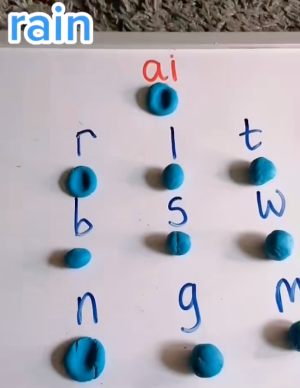
A simple way to make phonics instruction tactile is with Play-Doh or clay. Former primary school teacher Jennie Rees writes words on whiteboards, and places “sound buttons”—rolled-up balls and rods of Play-Doh—underneath them.
Students press the “button” and say or blend the sounds to read the word. One ball of Play-Doh is used when one letter makes a sound, while a rod of Play-Doh is used when two or more letters make a sound, such as with digraphs and trigraphs. For example, the word “star” would have a ball underneath the “s” and the “t” and a rod underneath the “ar.”
A similar strategy: Rees writes a primary letter sound at the top of a whiteboard with a ball of Play-Doh, and then a multitude of letters with more balls of Play-Doh underneath. For example, if the letter sound “ai” is written at the top of the board, Rees lists out possible pairings like “r,” “n,” and “st”—kids can press the Play-Doh for the “r,” then the “ai,” and then the “n” to make the word “rain.”
More games
Alphabet ball: In this game described by educator and literary specialist Jillian Marshall for We Are Teachers, teachers write letters on any ball big enough to throw—for example, an inflatable beach ball or a volleyball. Students then toss the ball among themselves. When someone catches it, they say the sound that the letter or letter pairing makes.
Phonics Hopscotch: To enter first-grade teacher Morgan Simpson’s class, students must bound across hopscotch mats that Simpson created for her students to practice their phonics.
The mats have squares filled with CVC words that are missing a letter—for example, some of the squares may be filled with incomplete words like: “_up,” “_ip,” and “_op.” Students must roll dice that have consonants, digraphs, or blends, depending on what each student is personally working on.
As they literally leap through the activity, they must sound out every single letter of every word. The daily phonics decoding practice was instrumental not only to their learning, Simpson explains, but also in helping her understand what her students were struggling with. “I’d know what to go back and talk to them about in a small group,” she says in the EdWeek video.
Flyswatter: All that teachers need for this game is foam, magnetic or even printed letters, and a flyswatter. To practice their letter-sound associations, students lay out the letters and swat each one as they verbalize its sound: C (swat!), A (swat!), T (swat!).