
Why Writing by Hand Beats Typing (in 6 Charts)
Typing may be faster, but the research shows that handwriting engages our brains in richer, more meaningful ways.
Your content has been saved!
Go to My Saved Content.It may sound archaic in today’s tech-centric classrooms, but researchers around the world are digging into the powerful effects of handwriting, revealing how the act of putting pen (or pencil) to paper significantly shapes how we think, remember, and make sense of new ideas.
Yet as schools increasingly prioritize digital literacy—for a range of purposes, including closing the digital divide and preparing kids for the workplace—students are spending considerably less time writing by hand.
Putting aside the swirling debate about classroom screen time, what’s lost when handwriting gets deprioritized in schools? Quite a lot, the research indicates. Writing isn’t just a form of communication; it fundamentally “transforms our cognitive abilities,” writes philosophy professor Richard Menary. In fact, he notes, the exquisite coordination of the external and neural processes transforms handwriting into “an act of thinking.” The invention of the alphabet nearly four millennia ago, for example, didn’t simply provide a new way to record language—it reshaped how we organized ideas, turning thought into something that could be seen, manipulated, and refined.
As brain scanning technology has advanced, neuroscientists have begun to see the clear links between writing by hand and the robust activation of brain areas involved with visual, motor, and linguistic functions, suggesting that handwriting plays a deeper, more foundational role in learning than previously known. Unlike typing, handwriting movements prime the brain for learning, making those first wobbly acts of letter formation a critical bedrock of literacy. “Children, from an early age, must be exposed to handwriting activities in school to establish the neuronal connectivity patterns that provide the brain with optimal conditions for learning,” researchers explain in an influential 2024 study.
Typing, and digital literacy more broadly, have their place in classrooms, of course. Assistive technology for students with learning disabilities is game-changing, and all students need to be technologically proficient to enter the workforce. Tech tools also expand access, collaboration, and creativity in classrooms. But as screens and devices take up more space in the school day, the latest research argues that handwriting should remain a central tool for thinking and learning.
A PEEK UNDER THE (NEURAL) HOOD
Compared with typing, writing by hand activates a broader network of brain regions—leading to a more durable “web” of learning.
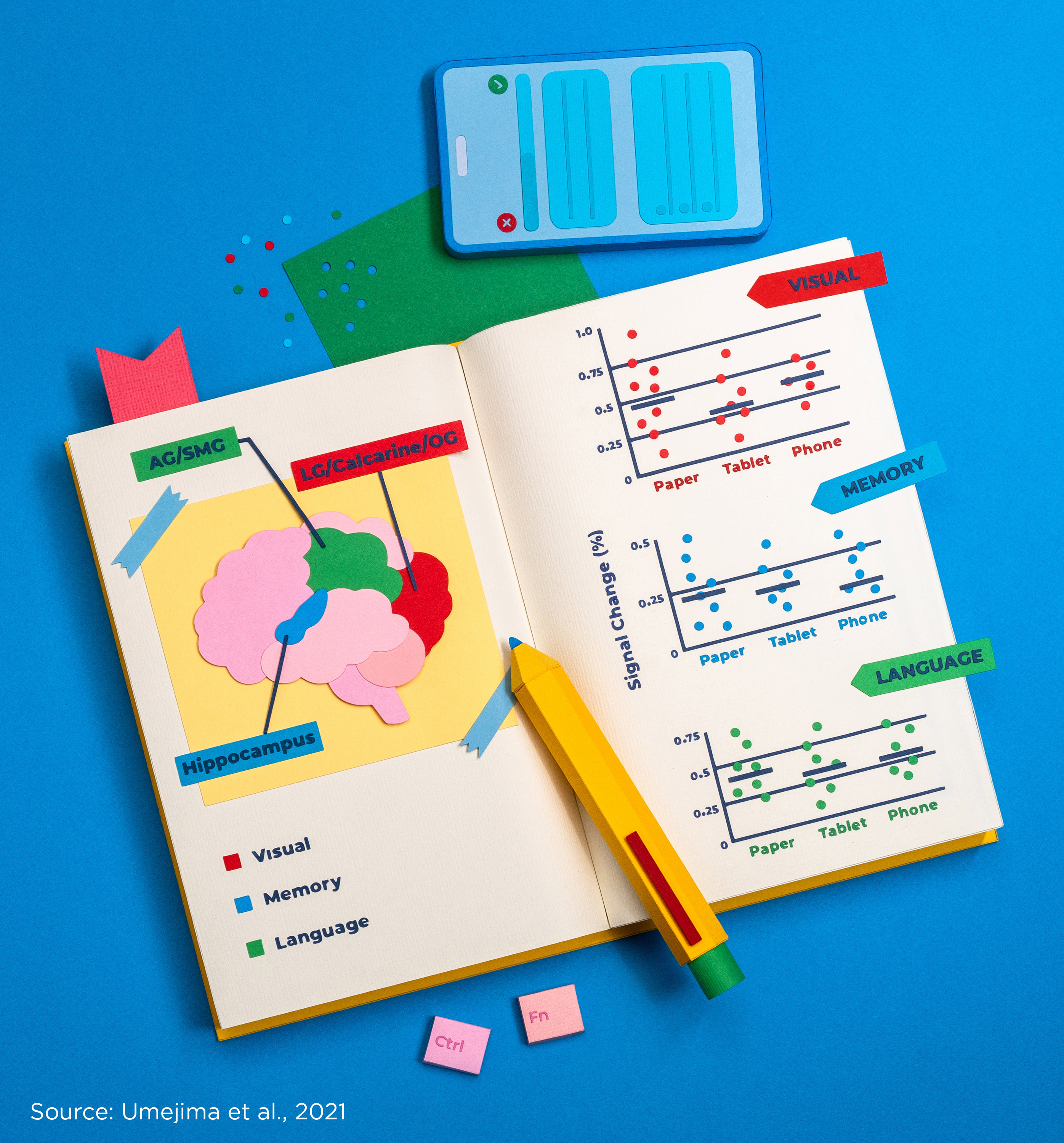
In a 2021 study, college-age students read a short passage describing a conversation and then wrote down key details—dates and times, for example—into one of three types of daily planners. While one group used pens with paper planners, another wrote on tablets using styluses, and a third group typed the information into smartphones. An hour later, the students, fitted with fMRI devices to measure brain activity, were asked to recall the details they had jotted down.
A peek into the brains of students who wrote by hand in the paper planners revealed widespread patterns of brain activity, spanning regions associated with memory, visuospatial processing, and language, providing compelling evidence that handwriting engages the brain in richer ways, creating more durable memory traces. Unlike typing, writing on paper provides “visual and tactile cues” that enhance the link between “episodic (what) and spatial (where) information, especially in the hippocampus,” the researchers clarify.
Digital screens offer a boundaryless workspace for writing information down—but they can’t replicate the tactile experience of a pencil moving across the textured surface of a page, or the visual feedback loop as the shape of each letter takes form while the brain guides the fine motor movements of the hand. “Whenever self-generated movements are included as a learning strategy, more of the brain gets stimulated, which results in the formation of more complex neural networks,” researchers state in a 2020 study.
A SURPRISING LINK TO EARLY READING
Handwriting gives early decoding and spelling skills a big boost.
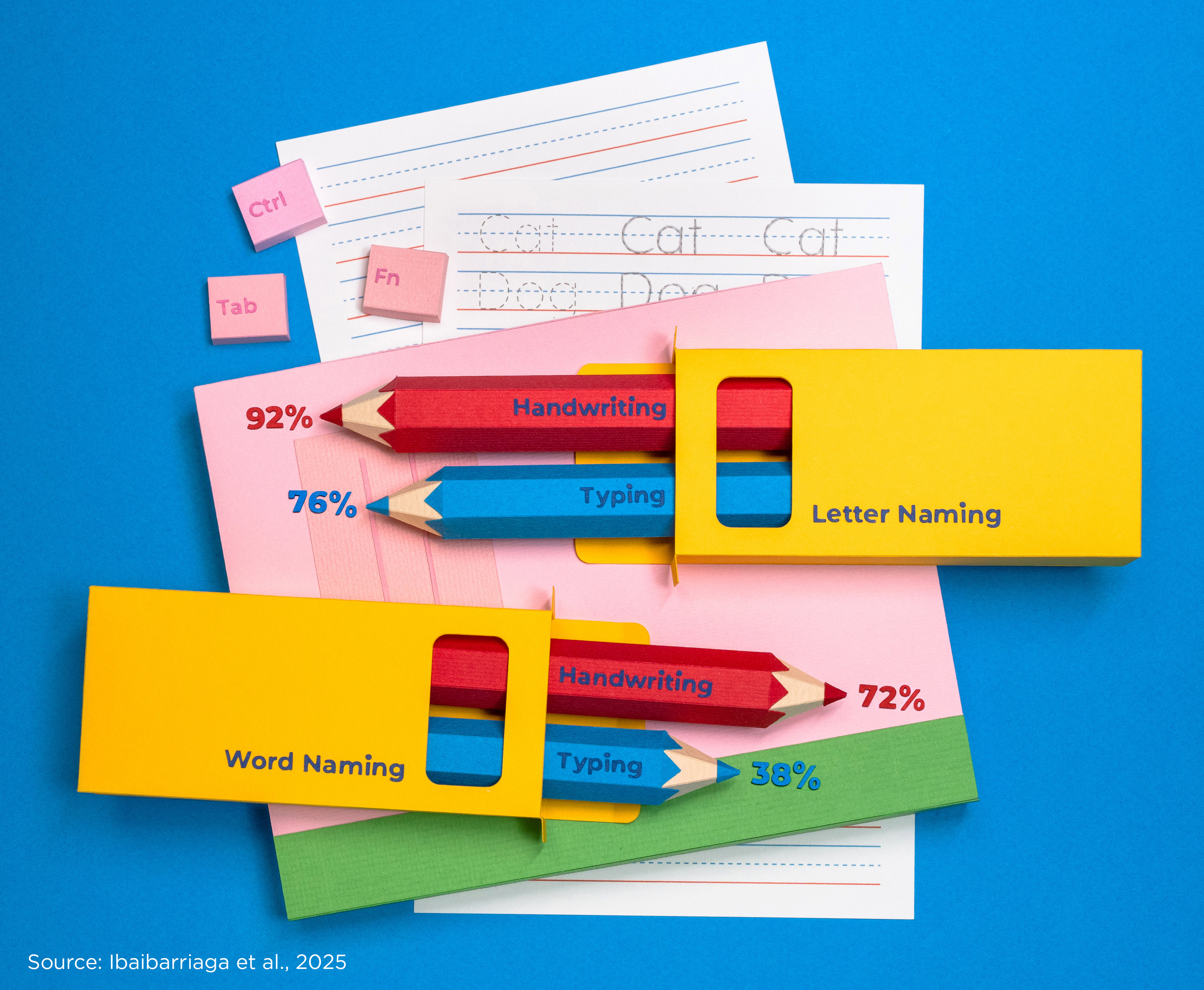
Responding to the recent “massive burst of digital media in the classroom,” researchers in Spain set about examining whether the “displacement of pencil and paper with typing on tablets or computers can alter the reading acquisition process.” To put the matter to the test, kindergarten-age children learned new letters by writing them by hand or typing on a keyboard, and were then asked to identify, sound out, and write a fresh set of short words using the newly acquired letters.
The results were striking, according to the 2025 study: Writing by hand showed clear superiority over typing—children who practiced forming the shapes of each letter showed faster gains across decoding and spelling tasks than their typing peers. When asked to name individual letters, the handwriters were 92 percent accurate, a 16-point advantage over their typing peers, who had 76 percent accuracy. For the more complex task of naming words—being able to read whole words aloud—the gap increased substantially, with handwriters beating typers 72 percent to 38 percent.
“Far from being merely a communication tool, handwriting is a critical component in developing the foundations of written language,” the researchers conclude, underscoring the fact that handwriting isn’t simply a manual skill—it’s a cognitive process that bolsters early literacy. The findings align with what teachers have long observed in classrooms: Introduce technology too early, and students may miss out on the experiences that underpin reading and writing.
“When students write letters manually, they learn them more effectively,” writes reading specialist Brooke MacKenzie. “Switching to keyboarding before students have developed handwriting skills may reduce their ability to recognize letters” and compromise reading skills long-term.
THE MEMORY ADVANTAGE FOR OLDER STUDENTS
When information is handwritten instead of typed, the details are more deeply encoded and easier to recall.
Once kids reach middle and high school, a time when note-taking becomes an everyday necessity, the research reveals another layer: The slower, more deliberate pace of capturing ideas by hand, on paper, translates into a sharper recall of details—even days later.
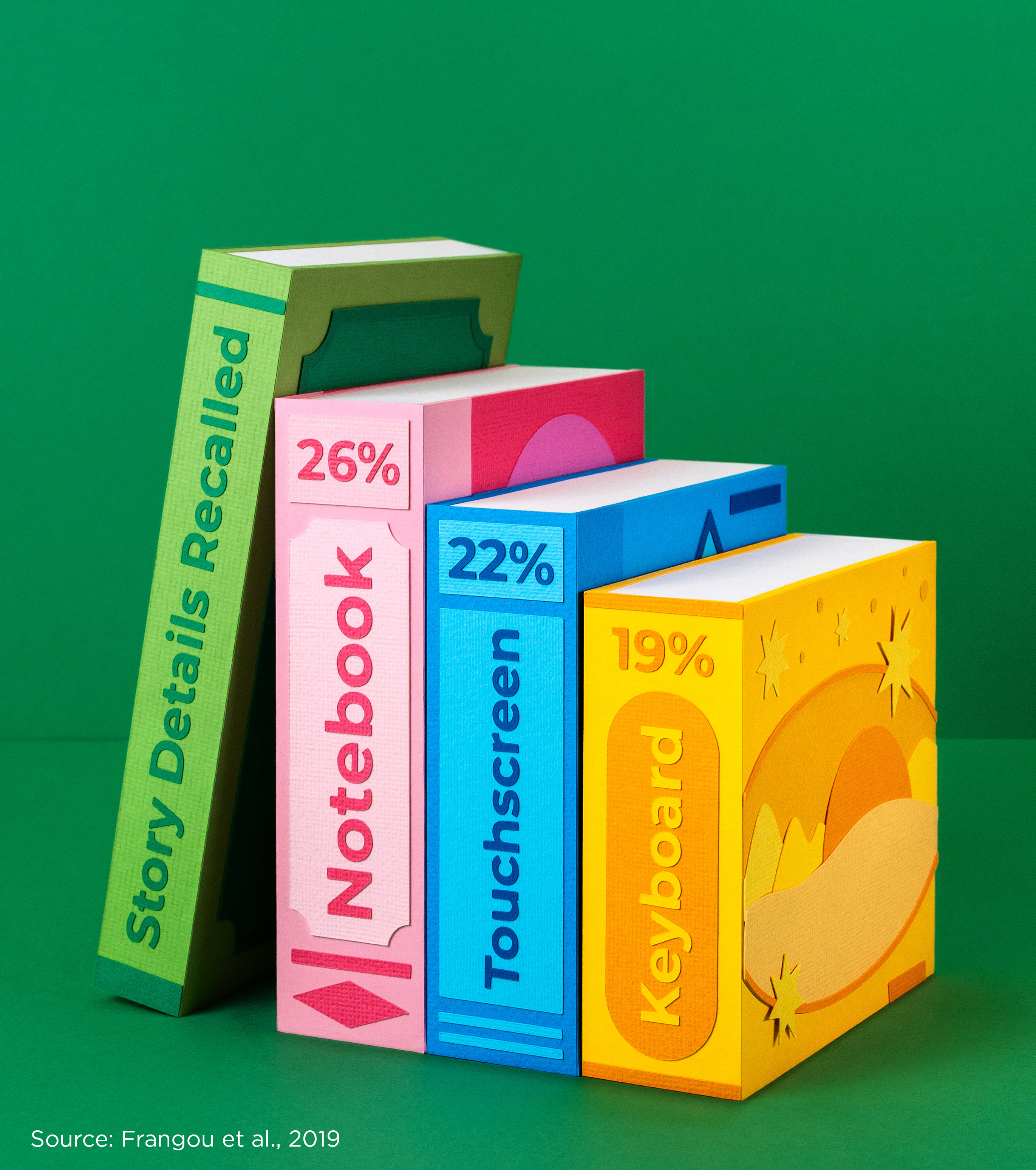
In a 2019 study, researchers asked fifth- and ninth-grade students to listen to short stories—about friends going on a fishing trip, for example—while transcribing the narratives into paper notebooks, touchscreen tablets, or laptops. One week later, the students were asked to recall as many details, characters, and events as they could from the stories. Across both age groups, kids who wrote notes by hand had stronger, clearer memories of the stories than those who used a tablet or laptop, the researchers discovered.
Among the ninth graders, recall scores were highest for handwritten notes, with 26 percent of story details recalled, compared with 22 percent for touchscreen users and 19 percent for laptop typers. Even among the younger fifth graders, handwriting produced stronger recall, with performance gains of about 10 percent compared with those who had used a laptop or tablet.
While handwriting is obviously “more time-consuming” than typing, the tradeoff is worthwhile, the researchers note. Capturing details on paper unites “fine motor skills, neuromotor processes, and multiple cognitive processes” in a way that forces students to engage more intensely with the material. Typing, on the other hand, can become “automated” and less cognitively demanding, leading to poorer recollection and a shallower understanding of the topic.
GOING SLOW, CONCEPTUALLY SPEAKING
When students write notes by hand, they’re more likely to slow down and process each idea—delivering astonishingly better results.
Navigating college without a digital device would be very difficult, if not impossible. And yet, there’s a significant cost to learning when pencils and paper are mostly removed from the equation, the research suggests.
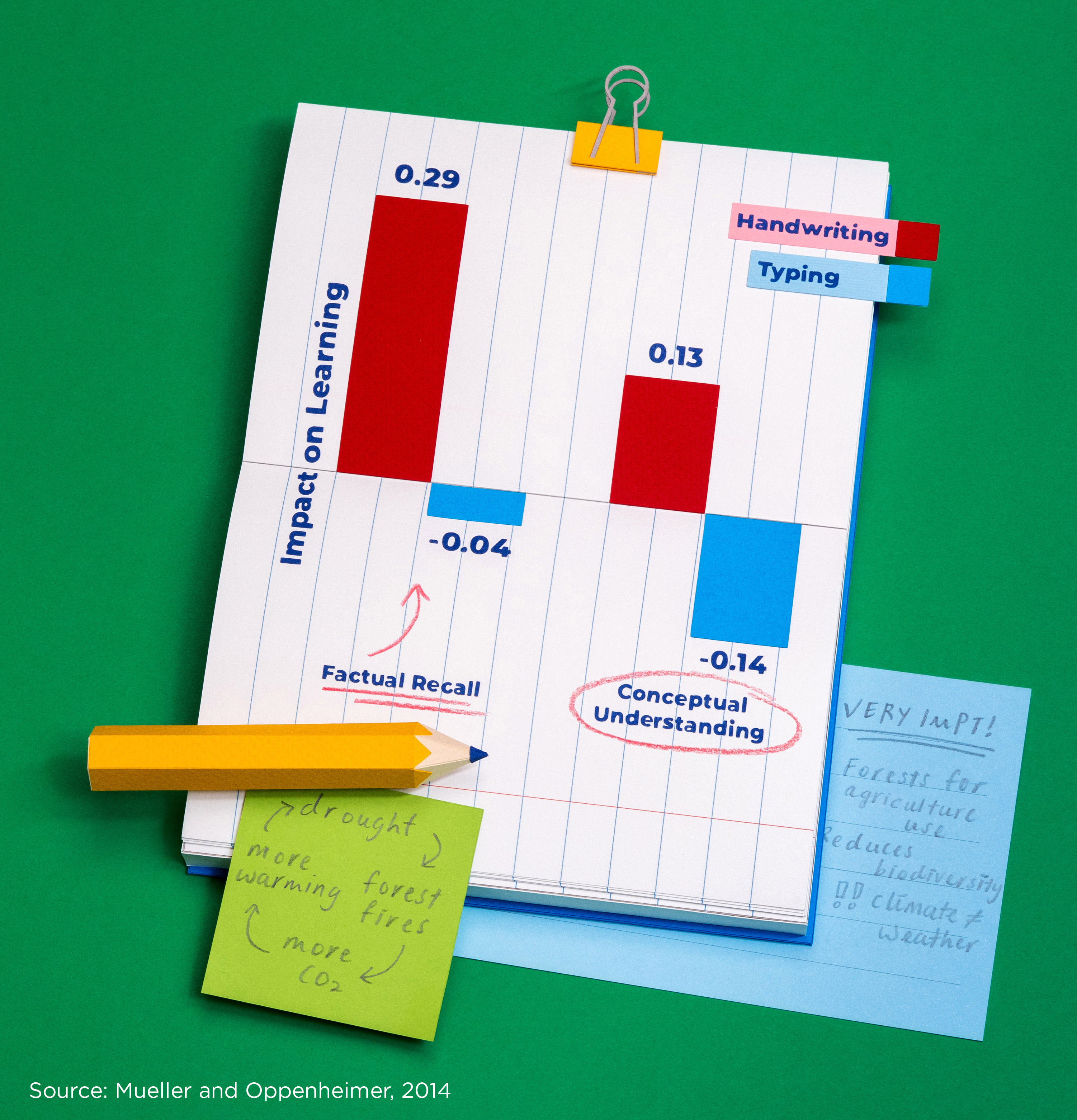
In a landmark 2014 study—reinforced by a 2024 meta-analysis—researchers asked college students to take notes either by hand or by laptop while watching video lectures, and then tested their factual and conceptual understanding of the material.
On conceptual questions such as seeing patterns, drawing conclusions, and making inferences, the hand-writing students scored 0.13 standard deviations above average—beating out 55 percent of other students. On factual recall, handwritten notes also won out, resulting in significantly stronger recall of key details from the lecture, likely because the notetakers needed to be more selective about what they jotted down, given the need to keep up with the lecture. Even when given the opportunity to study their notes, which would presumably give laptop users an advantage since they’d have “a more complete record” of the lecture, the pen-and-paper scribes scored 0.29 standard deviations above average—outperforming 61 percent of their peers—on factual information like historical dates and scientific definitions.
“Laptop use facilitates verbatim transcription of lectures,” which leads to “relatively shallow cognitive processing,” the researchers explain. Handwriting notetakers, however, are forced to slow down their minds and focus on broader principles and big ideas, rather than isolated facts, allowing them to connect new knowledge to existing knowledge they’ve already processed. It’s not that digital devices preclude all deeper processing, of course, it’s that students are more likely to revert to “transcription” mode when typing.
BETTER NOTES DELIVER BETTER GRADES
Students who write notes by hand are more expressive—and more likely to earn As and Bs than students who type.
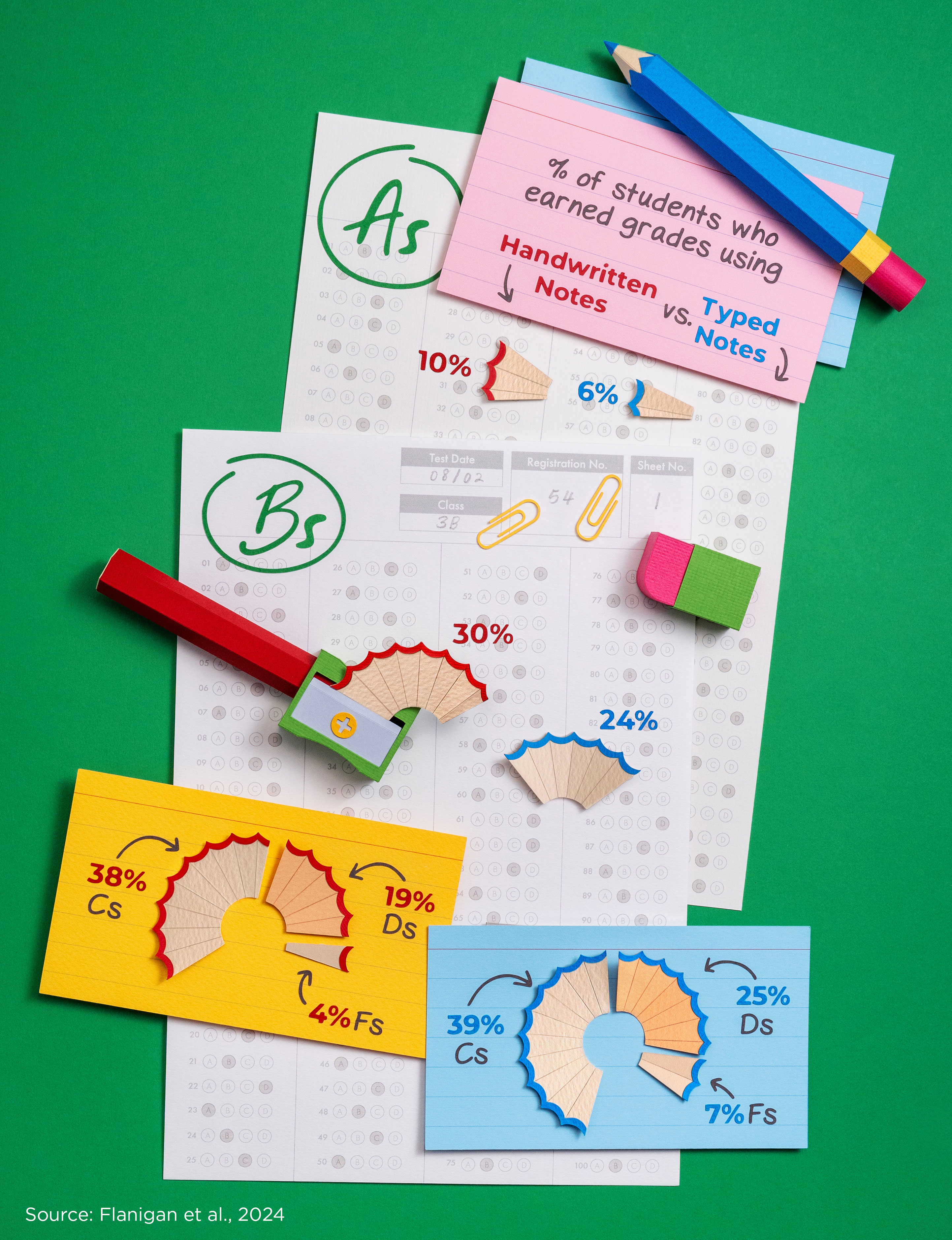
In a 2024 meta-analysis encompassing 24 studies, researchers analyzed academic performance for roughly 3,000 college-age students and found that students who took notes by hand were more likely to earn top grades, while students who typed were more likely to land in the D and F range.
The differences weren’t trivial, with roughly 40 percent of handwriters earning As and Bs, compared with just 30 percent of typers. Students who write by hand aren’t just jotting down ideas—they’re also more likely to see their notes as a “more personal and paraphrased” space to actively process and organize ideas, the researchers explain. A deeper analysis revealed that handwriting notetakers were much more likely to add drawings, diagrams, and charts of the material being learned: a sketch of the water cycle, for example, or visual annotations linking concepts together.
Meanwhile, the speed of typing came with a steep academic tradeoff, with 70 percent of typers earning Cs, Ds, and Fs, compared with 61 percent for handwriters. Despite being more efficient—and “wordy”—typed notes were generally devoid of personal touches like drawings and annotations, and were more likely to “capture lecture ideas in a verbatim, almost thoughtless way.”
BUT ALSO, TYPING CLOSES GAPS
Still, digital tools remain essential for making lessons accessible to all students.
For students who can keep up with the pace of a lecture with high-quality notetaking, handwriting delivers great learning advantages—but this capability isn’t within reach for every student. For English language learners, students with learning disabilities, and kids who simply write more slowly, for example, typing can be an important equalizer.
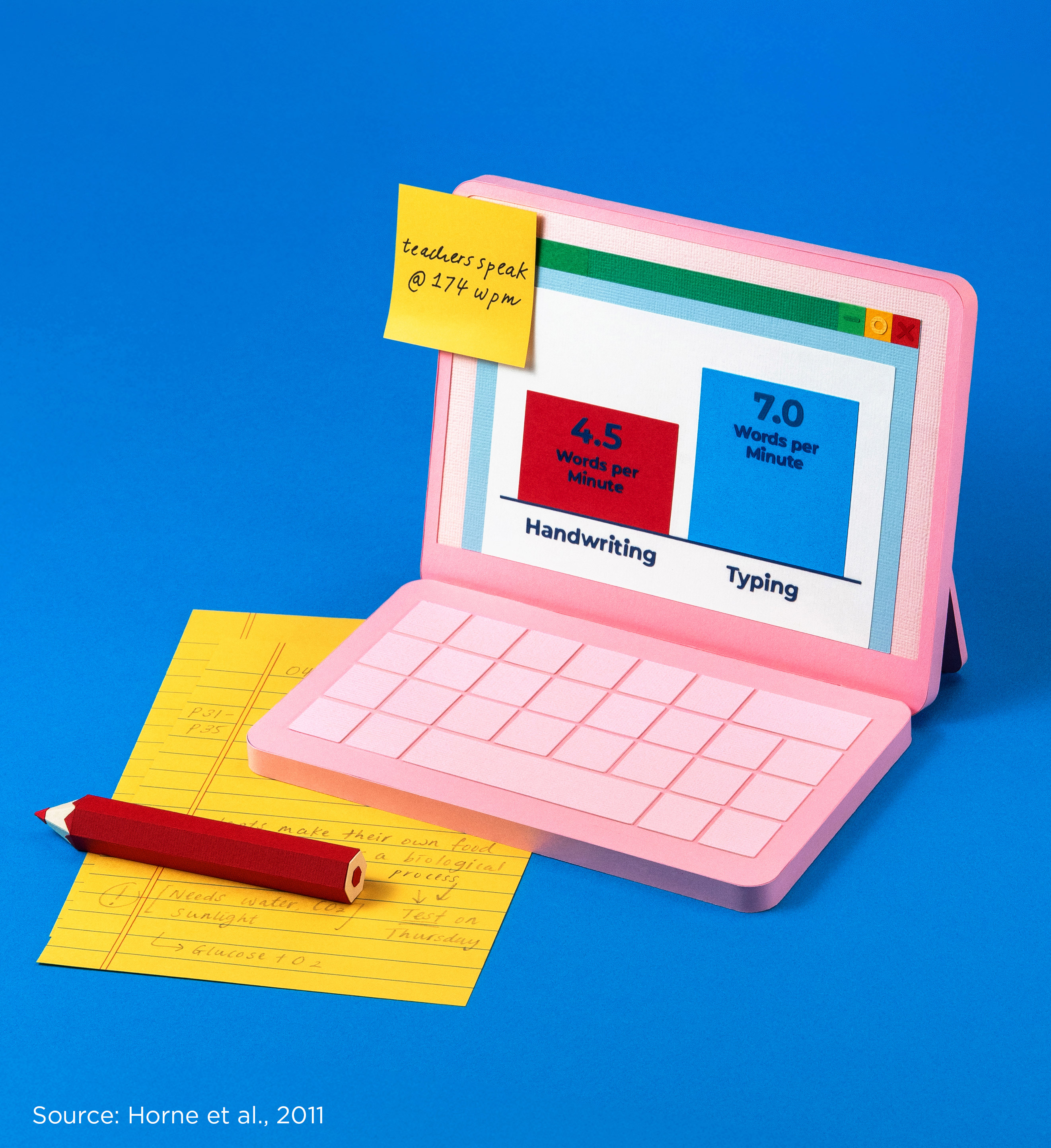
But even the snappiest notetakers will struggle to keep up. In a 2011 study, researchers compared typing and handwriting speeds for nearly 1,000 middle and high school students and found that using a keyboard was about 55 percent faster than writing by hand. That’s a meaningful gap, considering that teachers speak at an average of 174 words per minute—a rate that far exceeds students’ handwriting speed of 4.5 words per minute and typing speed of seven words per minute.
Ultimately, handwriting isn’t a panacea, and slowing down, integrating new information, and making important connections that solidify learning during digital notetaking is possible—it’s just unlikely in the day-to-day busyness of classrooms.
In the end, rather than asking which method is better, we may need to ask what opportunities each one provides. Handwriting—whether print or its cursive cousin—should be preserved and perhaps substantially expanded, but digital fluency should also be part of the mix. The most effective classrooms don’t pick one or the other, but balance them in ways that push students to think more deeply, be more creative, and engage meaningfully with ideas.
All paper art handcrafted by Cheryl Teo / Lulo Paper Studio. Art direction by Chelsea Beck.