
4 Questions That Spurred Real Innovation in My Grade Book
If you’ve ever wondered whether your grades really reflect student learning, these questions might help you get systematic about developing a new framework.
Your content has been saved!
Go to My Saved Content.Over a decade ago, I was carrying a printed copy of my digital grade book (don’t ask) to the office to submit final grades for the year when I had a thought that upended my grading and assessment practices. At the time, I was teaching in a school that, while beautiful and historic, was also over 100 years old and showing its age in places.
I looked down at the grade book and suddenly wondered, “What would next year’s teacher gain by getting my grade book?”
That single question began my quest to ensure that my grading practices weren’t as antiquated as the building I was teaching in. Throughout that journey, the most important changes I’ve made have been spurred by questions or by dilemmas I faced in the classroom.
Here are a few of those game-changing questions, along with changes I was able to make quickly and the deeper fixes that resulted in more meaningful change. I’ll also share a helpful book for exploring each question.
1. What Would Next Year’s Teacher Gain by Getting My Grade Book?
The question that started it all made me look at my grade book in a new way. If my goal was that my grade book would communicate current levels of learning, I found myself unable to find that information clearly. Instead, I was simply seeing a record of tasks. I could tell who was completing their assignments, who did well on tests, etc., but if I wanted to know which students were struggling with a certain skill and which ones were proficient, I would be out of luck.
I realized that, somehow, I had to make it more explicit how the numbers in my grade book corresponded to learning outcomes for my students.
Quick fix: Assignment tags. My first step in trying to make my grade book more clearly communicate what I needed was to simply tag each assignment with the learning outcome it connected to.
I did this in a myriad of ways. I tried adding the learning outcome in the title of the assignment, adding it in the description, and creating categories in the grade book that I sorted the assignments into.
Of all the options, while it required the most shifting, creating categories ended up being the most useful because I could actually pull up reports in my grade book based on each category. This ultimately led me to my deeper fix.
Deep fix: Standards-based grading. Shifting to a standards-based approach is one of the most important changes I have made, but before I jump in, I want to define what I mean by standards-based grading. For me it’s a record-keeping method, organized around learning outcomes, that identifies various attempts at demonstrating proficiency in those outcomes.
Switching to standards-based grading meant that my grade book’s primary function was to communicate how a student was doing on each of the learning targets covered in the course. The tricky part was that most online grading programs are not designed for keeping records in this manner. I kept a spreadsheet that I could organize how I needed to, and then transferred the relevant information into the online grade book.
While a little cumbersome at times, this method was really valuable. I was able to glance at my grade book and within seconds find my intervention group for a specific learning outcome or identify a few students who needed some challenge because they were already mastering the content. I had never been able to do all that with my traditional grade book.
Recommended reading: Grading Smarter, Not Harder, by Myron Dueck
2. How Is Growth Celebrated in My Grading?
In year three of my career, as I was beginning to question my traditional grading practices, I encountered a student who pushed me into a new dilemma. This student had come to the U.S. just a year before, and at the beginning of the year he was struggling with his writing. However, by the end of the term, he had grown immensely, performing proficiently or nearly proficiently in many areas.
Yet his final grade was still dismal.
I realized that my grading practice—the standard practice—of averaging the semester’s scores meant that I wasn’t truly grading his current abilities but was instead holding his earlier struggles against him.
As much as I talked about growth mindset and the importance of growing from mistakes, my grading practices were sending a completely different message. Averaging points over time and then using the average as the final grade wasn’t celebrating growth in the least.
Quick fix: Drop the lowest scores. There are many ways to minimize the impact of early mistakes on final grades. Some schools use a 50 percent minimum, but I have concerns with this practice. Some teachers allow replacement scores, where successful scores on later assignments replace lower scores on previous ones. I do like this, but it can be tricky to keep track of.
The method that was most useful to me was to simply drop the lowest score or two from a grading category (quiz, formative, classwork, etc.). This allowed students, like the one I mentioned, to move on from early struggles. If they grew, that growth was celebrated in their grade.
This also got me accustomed to a practice that became another foundational practice for me.
Deep fix: Mastery-based grading. Once again, it’s helpful to start with a definition. Mastery-based grading is the practice of prioritizing recent and consistent evidence to determine final scores for a learning outcome. This means that if a student has five attempts to demonstrate understanding of a standard, the early attempts are weighted less heavily or not counted at all in the final determination of proficiency in the skill.
This shift, which was made possible only by my initial shift to a standards-based approach, allowed me to truly make my classroom a growth-focused environment. It meant that a student who was struggling initially could end the term with a solid grade that represented their growth and current level of proficiency.
To do this, I would look at a student’s most recent scores in each learning outcome and use them to evaluate a current score. While some grading programs have this feature built in, this was a manual process that I did, often with the student, at the end of a unit or term.
Recommended reading: Ungrading, by Susan D. Blum
3. Do My Assessments Give Me the Information I Need About Student Learning?
Once I started organizing my grade book by learning outcomes, I realized that I needed to be much more precise in how I designed my assessments to ensure that I was getting information that accurately identified how well the student was doing with the skill being assessed.
Rubrics and learning progressions are essential, as they help ensure that projects and performance tasks are aligned to the learning outcome. However, I found that I was struggling with the design of my quizzes and tests. I was writing questions connected to a topic, but they didn’t really help me understand how well students understood the topic.
Quick fix: Assessment blueprints. An assessment blueprint allows you to take an existing assessment and map out how each question aligns to the standards being assessed, including the depth or complexity of each question. Using a blueprint allowed me to better use the information my assessments gave me, even without changing them.
For example, if I knew that question 7 was aligned to a specific standard at a highly complex level, the responses to that question could help me better understand how deeply a student understood the standard being assessed.
Blueprints also allowed me to do post-assessment reflection activities where students would analyze which questions they got correct and incorrect, and they could see which standards they were successful with and which ones they were struggling with.
Deeper fix: Learning progression assessments. I am a huge proponent of the learning progression, which is essentially a ladder that breaks a complex standard down into bite-sized chunks to help students understand what proficiency with a particular skill means. Once I started using them, I realized how valuable it would be to align my assessments to learning progressions.
They helped my students very clearly see how the assessment they were taking connected to their learning. Learning progressions allowed me to make students’ level of understanding visible and useful to them.
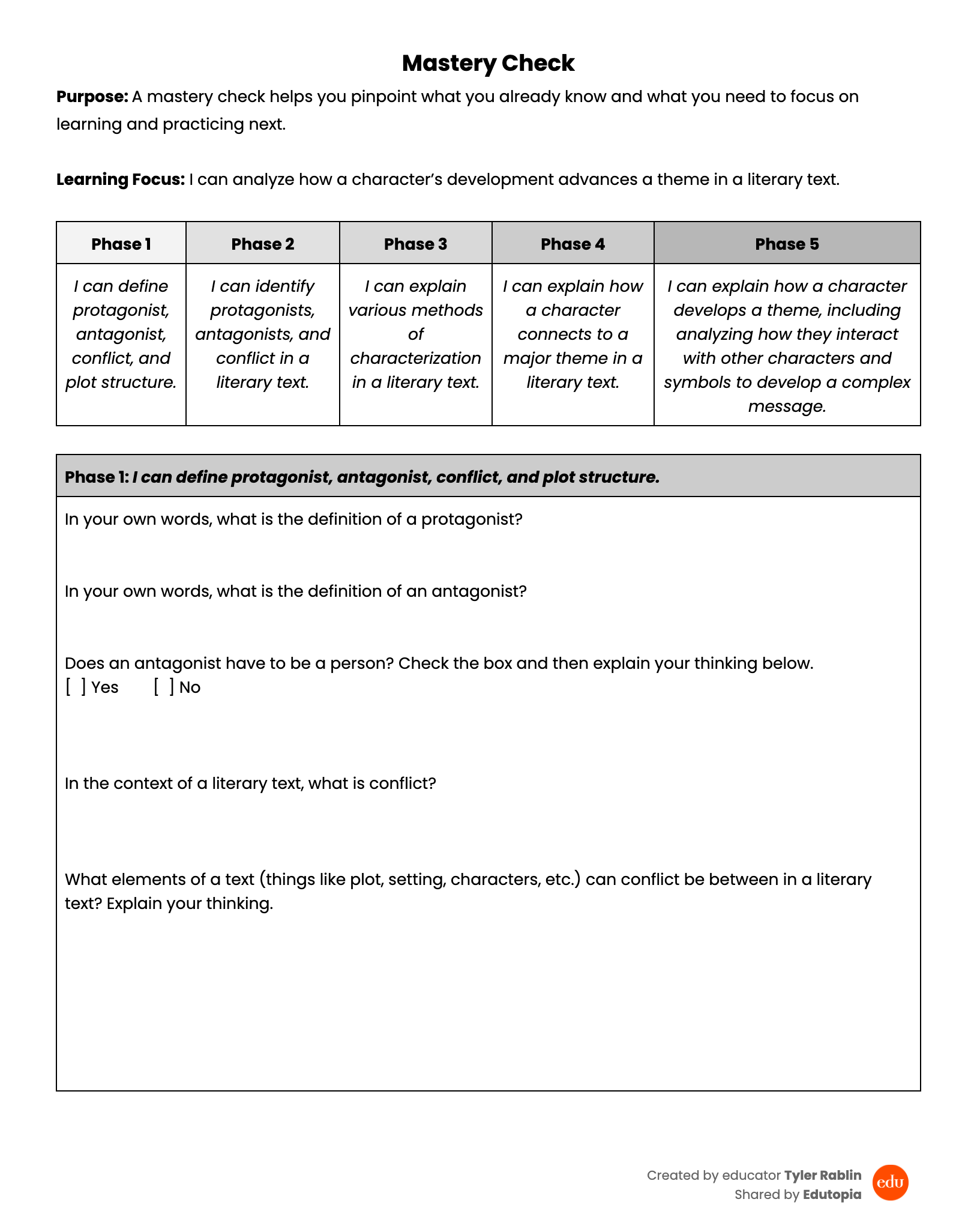
They also actually changed how I used assessments, which became living documents that we would revisit over and over throughout a unit—with students again attempting a section they had struggled over, taking notes on the assessment itself, and using a section as an entry or exit task to check whether or not they had grown in their learning.
Recommended reading: Hacking Student Motivation by… me
4. If I Couldn’t Use Numbers and Grades, What Would I Do?
Getting rid of numbers and grades is something most of us can’t do, but thinking about doing that is still worthwhile. This question forced me to think outside the box, and once I came up with an answer, I learned how to make that work inside the box.
One of the hardest things to avoid when it comes to grading is the influence of how it’s always been done. I think it’s important to acknowledge that grades are an arbitrary measure with no real basis in learning sciences. Grades don’t exist because they’re the best way to support student learning—they exist to institutionalize a practice of ranking that supports colleges and the workforce in their selection processes.
So what would you do if you couldn’t assign a number or letter grade to a student to communicate their learning? How might it change the way you provide feedback or communicate growth to a student? What would that process look like?
Those questions spurred me to begin using learning conferences—I would sit down with each student and talk about their progress. I realized that if I couldn’t just slap a grade on student work and move on, I would have to use a much more personal approach. I absolutely love learning conferences. They are my chance to connect with students, let them know I’m invested in their learning, and provide meaningful feedback to them.
With this question, there’s not really a quick fix or even a deep fix. This question encourages you to find your “What if…”—a big idea that feels like a stretch but that you know would be so valuable in your classroom.
Recommended reading: Point-Less, by Sarah M. Zerwin